
What actually happened in Germany?
During the Combined Resolve exercises held in April and May this year, Ukrainian drone operators repeatedly destroyed a 3,500-strong US armoured brigade — forcing exercise officials to “resurrect” eliminated vehicles simply so the drills could continue. The exercise took place at the Hohenfels training range in Germany. It was not a close contest.
The American contingent comprised roughly 3,500 service members, drawn primarily from the 3rd Armored Brigade Combat Team of the 1st Cavalry Division, rotating in from Fort Hood, Texas. Their mission was straightforward: attack enemy positions. The opposing force was reinforced by operators from Ukraine’s 412th “Nemesis” Regiment of the Unmanned Systems Forces. The outcome was not.
How did the Ukrainians prevail so decisively?
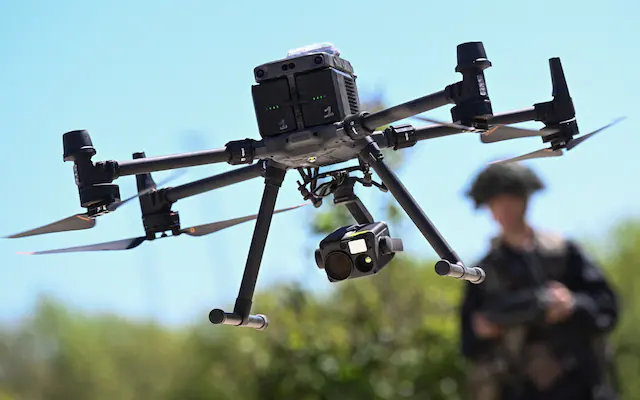
The mechanics of defeat were instructive. US forces deployed heavily armoured vehicles — the natural instinct of a conventional military. Those machines generated dust clouds that made them immediately visible to Ukrainian reconnaissance drones. Spotting was swift. Targeting followed automatically.
Officials briefed on the exercise, and at least one participant, confirmed that Ukrainian operators had eliminated a full US armoured brigade. That is not a marginal result. It is a comprehensive tactical defeat in a controlled environment.
Is this an isolated result, or part of a pattern?
It is emphatically a pattern. Combined Resolve was not the first exercise in which NATO forces have been bested by Ukrainian drone units. The same story has played out elsewhere:
The consistency across different theatres, different national forces, and different scenarios removes the possibility of dismissing any single result as an anomaly. Western militaries are encountering a repeatable problem.
Why does this matter beyond the training ground?
The Pentagon has spent billions of dollars in recent years acquiring drone technologies, counter-drone systems, and establishing specialist units. That investment has not yet translated into battlefield equivalence. The Combined Resolve results, taken alongside reported US losses in exercises involving Iran, point to a structural gap — not a budgetary one.
Ukraine has accumulated three years of live combat experience refining drone doctrine, tactics, and operator training under genuine operational pressure. That is not something that can be replicated quickly through procurement. Experience, it turns out, is not a line item.
The results raise direct questions about the readiness of US frontline units to operate effectively in any near-peer conflict where drone saturation is the norm rather than the exception. For defence planners and allied governments, that question is not academic.
What is the US Army doing with this information?
US Army Europe and Africa has deliberately used Ukrainian troop presence in exercises precisely to expose allied forces to hard-earned combat knowledge. The Combined Resolve exercise was framed around this objective, with a specific focus on tactical unmanned aerial systems. The defeats, in other words, were at least partly the point.
There is a meaningful difference between acknowledging a lesson and absorbing it institutionally. The wargame demonstrated that Ukrainian operators have developed a massive and measurable advantage over many Western militaries in modern warfare expertise. Closing that gap will require more than new hardware — it will require a serious rethink of doctrine, training cycles, and the organisational culture surrounding unmanned systems.
The dust clouds over Hohenfels carried a clear signal. The question now is how quickly Western defence establishments choose to read it.