Venice Biennale Controversy: Russia’s Return Draws Protests and EU Funding Threat
Russia’s return to the Venice Biennale — the world’s most prestigious international arts exhibition — has provoked sharp protests, a European Commission funding threat, and the resignation of the event’s entire international jury, as the 61st edition of the biennial fair opened this week.
Protests at the Russian Pavilion
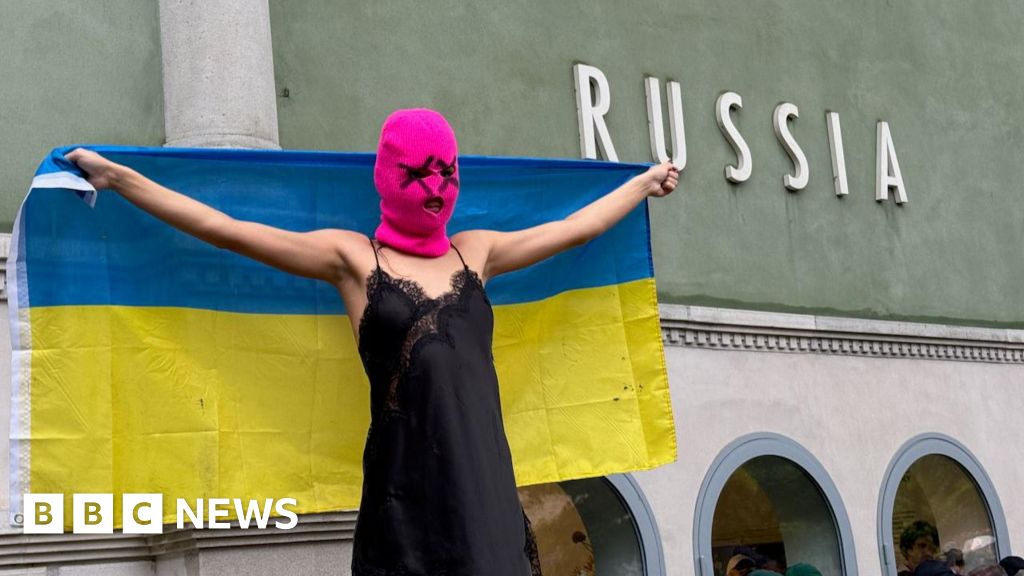
Activist groups Pussy Riot and Femen staged a joint demonstration in the Biennale’s gardens on Wednesday, setting off smoke flares outside the Russian national pavilion while chanting “Russia kills! Biennale exhibits!” The protesters, dressed in black with fluorescent pink balaclavas, held placards reading: “Curated by Putin, dead bodies included.”
Pussy Riot’s Nadya Tolokonnikova framed Russia’s participation as an instrument of hybrid warfare. “It’s not just tanks and drones, murder and rape in Ukraine,” she said. “It’s also culture, art, language — it’s the way Russia tries to conquer the West, and you guys just opened the doors to them.”
European Commission Threatens to Pull Funding
The European Commission has “strongly condemned” Russia’s reinstatement and threatened to withdraw €2 million in funding from the Biennale. The Commission argues that allowing Russia “to shine” on such a platform violates ethical standards attached to its grant.
Italy’s culture minister has declined to attend the public opening on Saturday in protest. However, Deputy Prime Minister Matteo Salvini — who visited Moscow’s Red Square in 2014 wearing a Putin T-shirt — has refused to join the boycott, stating that “no pavilion should be excluded.” A Brussels source indicated the Commission was unimpressed by Italy’s response.
Jury Resignation and Israeli Pavilion Protests
The controversy extends beyond Russia’s presence. Last week, the entire international jury resigned following a statement referencing countries whose leaders face International Criminal Court warrants for suspected war crimes — implicating both Russia and Israel.
On Wednesday, a separate group of protesters targeted the Israeli pavilion, carpeting the entrance with leaflets denouncing a so-called “Genocide Pavilion.” Israel’s foreign ministry had previously criticised what it described as a “political jury” turning the Biennale into a venue for “anti-Israeli political indoctrination.”
Biennale President Defends Inclusion
Pietrangelo Buttafuoco, the Biennale’s president and a right-wing former journalist who has spoken admiringly of Vladimir Putin in the past, broke his near-silence on the controversy to accuse critics of fostering a “laboratory of intolerance.” He condemned calls for exclusion as censorship.
“If the Biennale began to select not works but affiliations, not visions but passports, it would cease to be what it has always been: the place where the world meets,” Buttafuoco declared — before departing the press conference without taking questions.
His remarks drew immediate criticism. Posters plastered across Venice this week advertise an “Invisible Pavilion” featuring Ukrainian artists and writers, including Volodymyr Vakulenko, who was shot dead when Russian troops occupied his village. Each poster carries a single stamp: “Cancelled. Because the author was killed by Russia.”
Inside the Russian Pavilion
Russia’s pavilion — which was vacated by its own curators in protest in 2022 and subsequently loaned to Bolivia — now houses an upside-down tree installation and experimental sound performances organised by a Russian team.
The pavilion’s official commissioner, Anastasia Karneeva, dismissed questions about Russia’s presence. “This is our house, we come to our place,” she said, declining to address the protests. Karneeva’s father is deputy head of Rostec, Russia’s state-owned weapons conglomerate, which is subject to international sanctions — a topic she also declined to discuss.
Russia’s participation is, in practice, limited: the pavilion will close after this week’s pre-opening events, with performances to be screened externally. Whether this reflects the protests or the practical impact of sanctions remains unclear.
Ukraine’s Response: Art as Testimony
Positioned near the main entrance, Ukraine’s contribution offers a stark counterpoint. A concrete origami deer, suspended from a crane by heavy straps, is the work of Zhanna Kadyrova. The sculpture was originally installed in Pokrovsk, in eastern Donbas, when the front line lay nearly 40 kilometres away. By 2024, Kadyrova was forced to evacuate the piece to prevent its capture.
“We have a destroyed city that does not exist now,” Kadyrova said in a recent interview in Kyiv. “I hope this message is clear and people who visit the Biennale can understand it.”
Pokrovsk has since fallen under Russian occupation. “This was a lively city. And it does not exist now because Russia came,” she said. “The question is how many artefacts were not saved in this war? How many other kinds of heritage were destroyed?”
Additional reporting by Davide Ghiglione.