
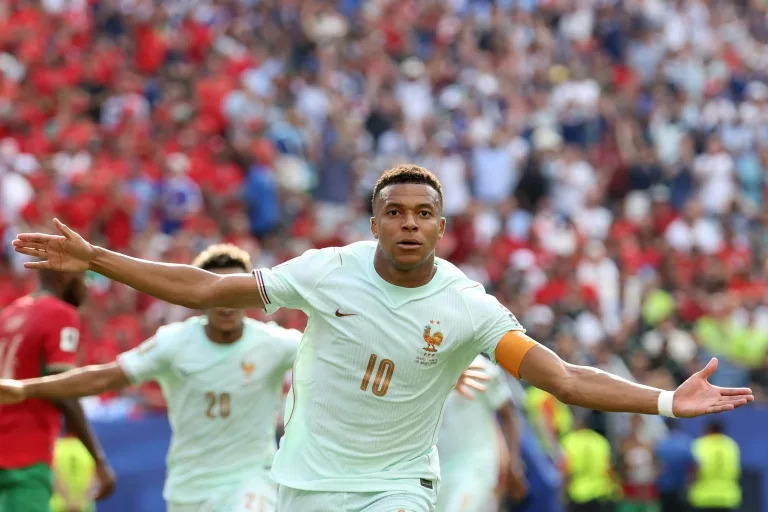
A Measured Victory in Boston
France secured their place in the World Cup semi-finals on Thursday with a composed 2-0 victory over Morocco at the Gillette Stadium near Boston, yet captain Kylian Mbappe was notably restrained in his assessment of the achievement, resisting any temptation to indulge in premature triumphalism. The win, while ultimately comfortable in its margin, was far from straightforward, and Mbappe himself endured a testing evening before making his mark on proceedings. His first-half penalty was saved, a moment that might have unsettled a less experienced side, but France demonstrated the kind of tournament resilience that has characterised their recent World Cup campaigns.
Speaking to French broadcaster M6 in the aftermath of the match, Mbappe struck a tone of deliberate pragmatism that will reassure those who have watched previous French squads succumb to complacency at the later stages of major tournaments. “We are in the semi-finals and we are very pleased,” he acknowledged, before adding the caveat that defined the tenor of his remarks: “There is still a long way to go and we are aware that what awaits is going to be even harder, but we are ready.” It is the kind of measured self-awareness that distinguishes a side that understands the weight of expectation from one merely performing humility for the cameras.
Mbappe’s Personal Performance and Fitness
A Penalty Miss Followed by a Decisive Contribution
The narrative arc of Mbappe’s evening encapsulated the broader story of the match itself. The saved penalty in the first half threatened to become a defining moment of misfortune, but Mbappe recovered to open the scoring and then played a direct role in Ousmane Dembélé’s goal that sealed the result, demonstrating once again his capacity to shape a game even when operating below his best. That combination of individual resilience and collective contribution is precisely what France will require as the tournament enters its most demanding phase.
Ankle Concern and Precautionary Substitution
There will, however, be some concern over the knock Mbappe sustained to his ankle late in the match, which prompted manager Didier Deschamps to withdraw him in favour of Jean-Philippe Mateta for the final quarter-hour. Mbappe was characteristically direct in his assessment of the situation, stating simply: “I’m fine. I took a knock on the ankle but I’m fine. I think at that point JP was more prepared than me to play the final 15 minutes so I came off.” Whether this represented a genuine precaution or a more significant concern will become clearer in the days ahead, though Mbappe will fully expect to be available for the semi-final.
The Road to Dallas and the Stakes Ahead
France now travel to Dallas, where they will contest a semi-final on Tuesday, 14th July — a date that carries its own particular resonance for a French nation that will not overlook the Bastille Day symbolism — against the winner of Friday’s quarter-final between Spain and Belgium. Both opponents represent formidable challenges in their own right, with Spain’s fluid positional play and Belgium’s experienced core offering markedly different tactical problems for Deschamps to solve. The identity of their opponent will shape France’s preparation considerably, and Mbappe confirmed that the squad intends to watch Friday’s match with that analytical purpose in mind.
When asked whether France felt they were on some kind of mission to reclaim the trophy they last won in 2018, Mbappe pushed back gently on the romanticism of that framing. “I don’t know if you can say we are on a mission. That is the easy term to use. But I think we are aware that the only way to let up is by winning,” he said, a formulation that reveals a squad oriented not around narrative but around outcomes. It is, in its own way, a rather businesslike disposition — and for a nation with France’s footballing resources, that is perhaps exactly the right one.
Historical Context and the Weight of Expectation
France’s World Cup pedigree lends genuine substance to their ambitions. They claimed their first title on home soil in 1998 under Aimé Jacquet, followed by a second triumph in Russia in 2018, and came agonisingly close to a third in Qatar in 2022, only to lose on penalties to Argentina in a final widely regarded as one of the finest in the tournament’s history. That defeat, which came after a remarkable second-half fightback, will have sharpened rather than diminished the squad’s appetite, and Mbappe in particular carries the memory of a final in which he scored a hat-trick and still finished on the losing side — a statistical anomaly that speaks to the cruelty of the occasion as much as any individual failing.
The semi-final represents, therefore, not merely a sporting milestone but a moment of genuine historical possibility. France possess the squad depth, the tactical flexibility, and — if Mbappe’s words are any guide — the psychological discipline to mount a serious challenge for the title. Whether the tournament ultimately delivers on that potential will depend on the margins that invariably decide contests at this level: fitness, form, and the particular fortune that no amount of preparation can fully manufacture.