Saxony’s Minister-President Advocates Diplomatic Realism on Ukraine War
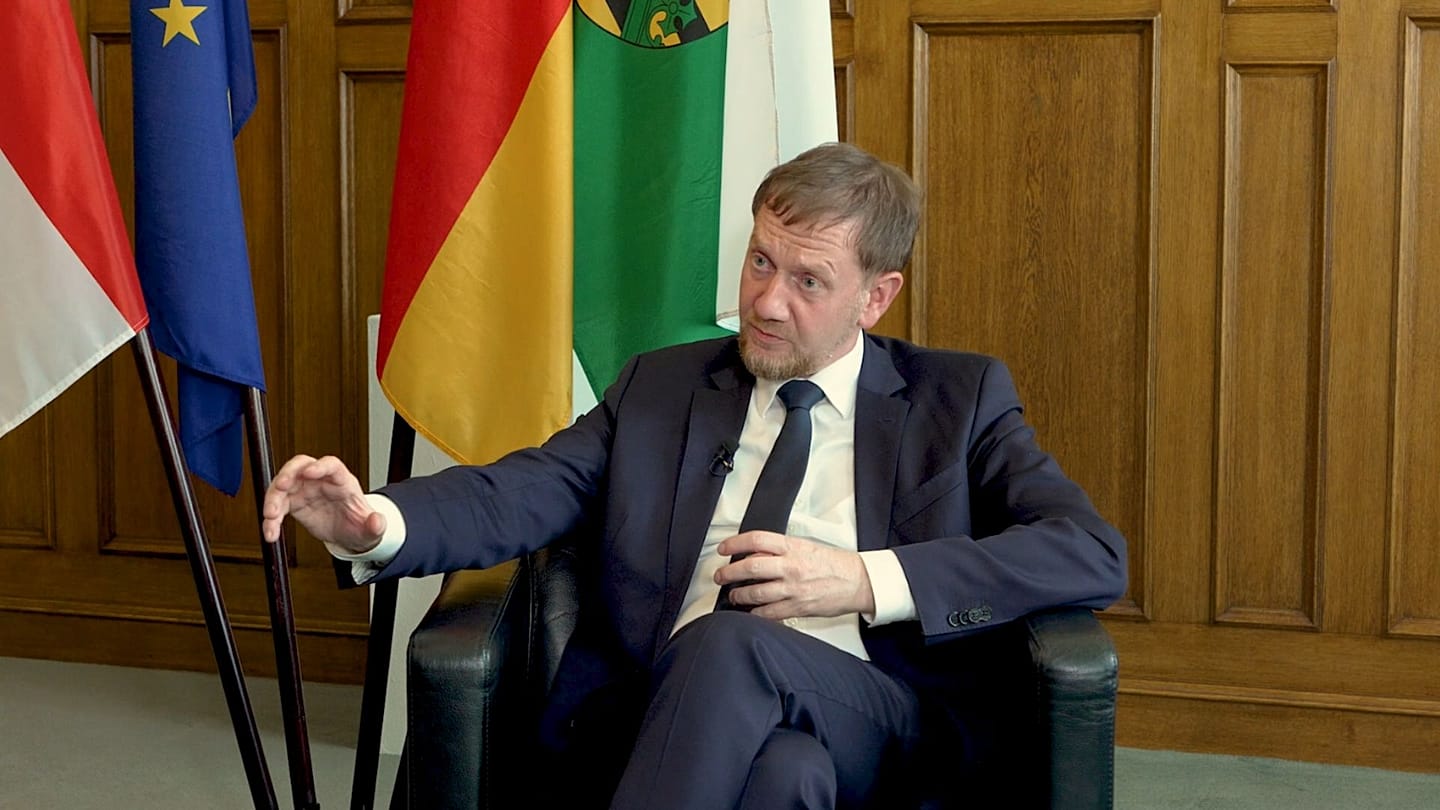
Michael Kretschmer, Minister-President of Saxony and vice-chairman of the CDU, has called for a pragmatic reassessment of Germany’s approach to the Ukraine conflict, arguing that economic self-interest, diplomatic engagement, and welfare reform must sit at the heart of Berlin’s policy. He made the remarks in an interview with Euronews at Saxony’s official state representation in Berlin.
Russian Gas: Back on the Table After Peace
Kretschmer declined to rule out a resumption of Russian gas supplies once a peace settlement is reached. “Once there is peace, we can, should, and must talk about such matters,” he told Euronews.
The Saxon premier has consistently advocated for negotiations with Moscow, contending that the conflict cannot be resolved by military means alone. He expressed scepticism about supplying Ukraine with German-made Taurus long-range cruise missiles, warning that Germany risked becoming a direct party to the war. “From my perspective it has already gone far too far,” he said.
Kretschmer also pushed back against critics who question the motives of those opposed to expanded military support, calling such characterisations “morally completely over the top and, in my view, also unacceptable.” He argued that broader diplomatic coalitions — including China and India — are indispensable to any lasting settlement.
Sanctions Must Be ‘Smart’ to Protect German Economic Strength
On economic sanctions, Kretschmer struck a carefully calibrated position. He affirmed that Russia’s invasion of a sovereign state must carry consequences, stating: “Not a single square metre of Ukraine, not even Crimea, has become Russian.”
However, he insisted the operative word in any sanctions strategy must be “smart.” Measures that primarily damage the German economy, he argued, are self-defeating. “They must not be designed in such a way that they jeopardise our economic strength,” he said.
Kretschmer linked economic resilience directly to defence capacity, arguing that Europe’s ability to fund systems such as a missile defence shield depends on maintaining a robust industrial base. The goal, he said, is to act rationally in order to compel an aggressor to the negotiating table — not to impose costs that rebound on Germany itself.
Citizens’ Allowance for Refugees: ‘A Big Mistake’
Kretschmer was equally direct on domestic refugee policy, describing the federal government’s decision to grant Ukrainian refugees access to Germany’s citizens’ allowance as “a big mistake.”
He cited a stark disparity in employment outcomes: in France, Poland, the Czech Republic, and the Netherlands, refugee employment rates rapidly reached 70–80%, while Germany remained at 20–30%. Kretschmer attributed this gap not to the refugees themselves but to the structure of German welfare policy, which he said removed the incentive to seek work.
He also indicated that the EU’s Temporary Protection Directive — activated in 2022 to grant Ukrainians rights of residence, work, and social benefits without lengthy asylum procedures — should be allowed to expire next year and not renewed. “We can see that there are large parts of Ukraine where people can live well and safely,” he said, adding that Ukraine’s reconstruction requires the return of its population.
Municipalities Need £100 Billion in Structural Support
Kretschmer, alongside his counterparts from Bavaria, Mecklenburg-Western Pomerania, and Saarland, secured a commitment during coalition negotiations for municipalities to receive €100 billion from a dedicated special fund.
“We cannot provide funding for armaments or equipment for Ukraine while hospitals, schools, nurseries, sports facilities, and fire brigades in our municipalities are being left behind,” he said.
He framed the funding condition as a matter of democratic principle: the federal government bears responsibility for ensuring that local democracy remains financially viable, particularly where underfunded federal legislation has created structural gaps in municipal finances.