
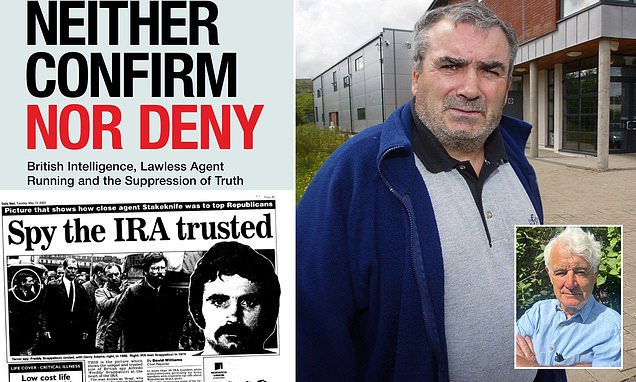
The declassification of a long-concealed internal memorandum has reopened one of the most troubling chapters in British intelligence history: the handling of Freddie Scappaticci, widely believed to be the double agent codenamed Stakeknife, and the extraordinary lengths to which MI5 went to preserve his operational usefulness — irrespective of the crimes he committed in doing so. The central thesis that emerges from Operation Kenova’s findings is uncomfortable but inescapable: the Security Service allowed a man linked to fourteen murders and fifteen abductions to operate with near-total impunity, not because the intelligence calculus genuinely justified it, but because institutional loyalty to a prized asset had displaced both legal accountability and moral judgement.
That is a serious charge, and the evidence assembled over nearly a decade of investigation substantiates it in considerable detail.
An Asset of Questionable Value, Protected at Considerable Cost
Scappaticci was recruited by the British Army in the 1970s and spent the better part of two decades embedded within the IRA’s internal security apparatus — the so-called nutting squad — which was responsible for identifying, interrogating, and executing suspected informers. The grotesque irony of his position, an informer running the unit tasked with hunting informers, was not lost on investigators. During his time undercover, he submitted 3,517 intelligence reports and received hundreds of thousands of pounds in payments from the state. On those figures alone, his handlers could construct a plausible case for his value.
But Operation Kenova, the £47.5 million police inquiry that concluded after nearly a decade of work, reached a far more damning verdict. Its final report concluded that Scappaticci’s actions probably resulted in more lives being lost than saved — a finding that fundamentally undermines the utilitarian justification that MI5 had long relied upon to explain its protection of him. The Service had previously described its involvement with Scappaticci as “peripheral”; the Kenova report found this characterisation to be flatly wrong, establishing instead that MI5 was “closely involved in his handling” and had “automatic sight of all Stakeknife intelligence” — meaning it was fully aware of his participation in serious criminality as it occurred.
The memo now brought to light reportedly details a four-point plan devised by MI5 to reinsert Stakeknife into the heart of IRA operations after he had spent two years on the run following his exposure by the media in 2003. That period of concealment, the investigation found, included taxpayer-funded excursions that stretched the definition of operational necessity to its breaking point. The willingness to sustain him through this period, and then to engineer his return to active intelligence work, speaks to an institutional mindset in which the asset’s continuation had become an end in itself.
Institutional Loyalty as a Perversion of Duty
Operation Kenova’s investigators identified what they described as a “perverse sense of loyalty” within MI5 toward Scappaticci — a loyalty that manifested in concrete and consequential ways. Twice, the Security Service removed him from Northern Ireland on what were characterised as holidays, despite knowing that police sought him in connection with conspiracy to murder and false imprisonment. These were not marginal or ambiguous decisions; they were deliberate acts of obstruction dressed in the language of asset protection.
The report’s criticism extends beyond the handling of Scappaticci himself to MI5’s conduct during the investigation. Investigators found multiple instances in which the Service delayed the release of key documents, with several episodes interpreted as attempts to “restrict the investigation, run down the clock, avoid any prosecutions, and conceal the truth.” These are the words of a formal police inquiry, not polemical commentary, and they deserve to be taken at face value. When an intelligence agency behaves in ways that a serious investigative body characterises as obstructive, the damage extends well beyond the immediate case — it corrodes the institutional trust upon which effective oversight depends.
Scappaticci died in 2023, having admitted IRA membership but consistently denied being Stakeknife. He was never prosecuted. The Kenova report has called on the UK government to apologise to bereaved families and survivors, and has made the case that there is a “compelling ethical case” to name Stakeknife publicly. MI5 Director General Ken McCallum offered an apology for the late disclosure of documents and expressed sympathies to victims’ families — a gesture that, while not without significance, falls well short of the structural reckoning the findings demand.
The Implications for Intelligence Accountability
What the Stakeknife affair ultimately exposes is not merely a sequence of operational misjudgements, but a systemic failure of governance within the intelligence community. The question of how far an agent handler may go in shielding a source from legal consequences is not a new one; it arises wherever covert human intelligence operations intersect with the rule of law. What distinguishes this case is the scale of the criminality involved, the duration over which it was permitted, and the active steps taken to prevent accountability from catching up.
A functioning oversight framework — one with genuine teeth and genuine independence — should have intervened long before a police inquiry costing nearly fifty million pounds became necessary to establish facts that MI5 had possessed all along. The lesson for policymakers is not that human intelligence operations are inherently corrupting, but that they require robust, real-time scrutiny precisely because the institutional pressures that led MI5 astray in this case are structural, not incidental. Without that scrutiny, the perverse logic of asset protection will always tend to expand until it consumes the very principles it was meant to serve.