

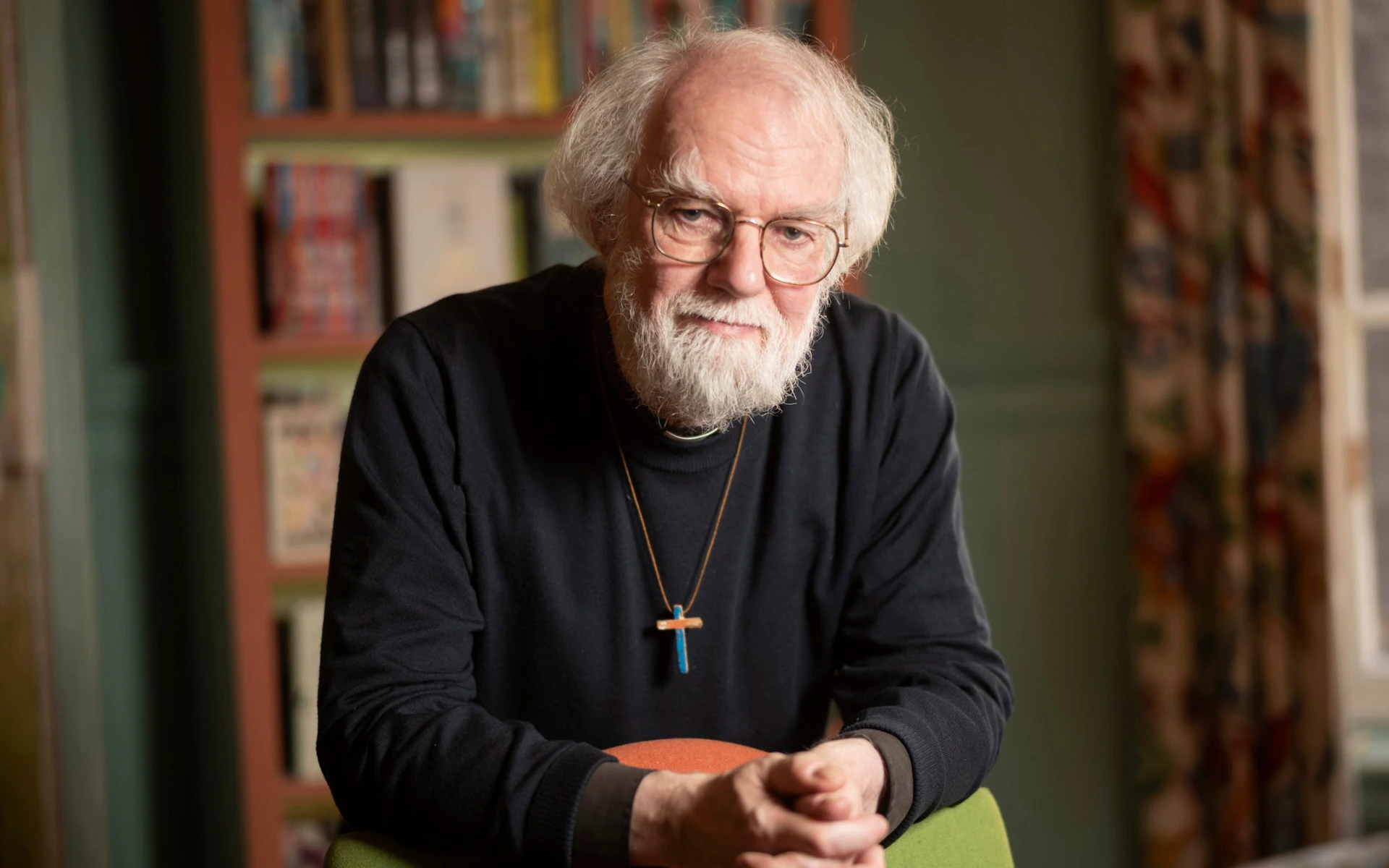
Rowan Williams says he will not attend Sarah Mullally’s installation as Archbishop of Canterbury. He frames that choice with dry humor, saying he does not want to appear like “Marley’s ghost”. Yet his tone soon turns serious. Williams, who led the Church of England from 2002 to 2012, says Mullally begins the job under the same pressure that confronts any major public leader: expectations arrive at once, and many cannot be met. In his view, the office remains one of the hardest in British public life.
That judgment carries weight. Mullally took office in January 2026 after her confirmation of election, becoming the first woman to lead the Church of England. Her formal installation at Canterbury Cathedral follows a period of deep institutional strain after Justin Welby resigned in November 2024 over the fallout from the Makin review into the Church’s handling of abuse by John Smyth. Against that backdrop, Williams presents Mullally’s task as both immediate and historic.
Old arguments still rule the agenda
For Williams, the central disputes on Mullally’s desk are familiar. He points first to women’s ordination and then to what he calls “the same-sex question”. On women’s ministry, he suggests some of the bitterness has eased inside the Church of England. However, he does not extend that optimism to the wider Anglican Communion, the global network of Anglican churches in more than 160 countries. There, divisions over women’s leadership and sexuality remain sharp.
His assessment is stark. Williams says he does not know whether the Communion will survive in its present form. That is not just a comment on theology. It is also a judgment about authority. The Archbishop of Canterbury has moral influence across the Communion, but not direct control over its provinces. When national churches move at different speeds on doctrine and practice, unity becomes harder to sustain.
That tension has shaped the Church of England’s long debate over same-sex blessings. In 2023, bishops backed the use of Prayers of Love and Faith for same-sex couples within existing services. Later proposals for standalone services, however, stalled after years of dispute. Williams avoids directly condemning that reversal. Instead, he returns to a familiar principle: the archbishop’s role is to hold people together even when agreement proves impossible.
Safeguarding now defines the moral test
The issue that most sharply frames Mullally’s inheritance is safeguarding. In the Church context, safeguarding refers to the systems meant to protect children and vulnerable adults from abuse and to ensure complaints are heard and acted on. The Church of England’s failure on that front now stands at the center of its crisis of trust.
Williams does not try to soften that reality. He calls it a “terrible Christian failure” and says the Church has not only failed to communicate human dignity but has often modeled the opposite. That language matters because it shifts the issue from administration to witness. In his account, safeguarding is not a side problem for church managers. It is a direct test of whether the Church lives by the values it preaches.
The shadow of past decisions also falls across Williams’s own record. He says he still loses sleep over the failed 2003 nomination of Jeffrey John as Bishop of Reading. John, an openly gay priest who was then in a same-sex relationship, withdrew after fierce opposition from conservative Anglicans. The episode became a defining moment in the Church’s conflict over sexuality. Williams does not revisit the details at length, but his regret shows how unresolved that period remains.
A book about solidarity arrives at a revealing moment
Williams’s new book, Solidarity: The Work of Recognition, appears at a moment when the Church and wider society both look fractured. He argues that solidarity goes beyond sympathy. In his view, it means recognizing interdependence, shared dignity and mutual obligation. That idea runs through his reading of politics, faith and public life.
He points to examples as different as the Polish Solidarność movement and public expressions of support for Palestinians in Gaza. The thread, for him, is the claim that people do not flourish in isolation. Security, he argues, cannot be fully private. A person is secure only when a neighbor is secure too.
This is also where his analysis widens beyond the Church. Williams sees many people “running for the corners of the room”, pushed there by rapid social change, environmental anxiety and a sense of lost control. He describes a growing belief that the gains of one group must come at the expense of another. In that climate, solidarity becomes harder to imagine and easier to dismiss as ideology.
Not a partisan argument but a moral one
Williams rejects the idea that solidarity belongs only to the political left. He insists it rests on a more basic question about what it means to be human. That claim shapes his views on immigration and human rights. He warns against treating rights as a simple bundle of individual claims detached from mutual responsibility. At the same time, he argues that the danger in public life comes when institutions begin to imply that some people do not fully count.
His broader criticism of British life is severe. He says public life has lost its moral center. He points to declining standards of truth-telling and to a coarsening of political culture, especially in the language used by people who hold office. In his view, public dignity is not ceremonial. It is part of the duty that office imposes.
The same concern appears in his response to religious identity being used as a political badge. Asked about proposals to protect Christian churches from conversion into mosques, he sounds wary. He suggests such arguments can turn Christianity into a cultural boundary marker rather than a faith. For Williams, that approach deepens division instead of renewing belief.
Mullally faces a burden that has only grown
Williams does not say the archbishop’s role is futile. He says he never doubted it was worthwhile. Yet he admits there were many moments when he felt he could not do it, and even more when he did not want to do it. That candor may be one of the clearest insights he offers into the office Mullally now holds.
His comments leave little doubt about the scale of her challenge. She must lead a Church still dealing with safeguarding failures, still divided over sexuality and authority, and still unsure how much unity remains possible across the Anglican world. Williams’s answer is not a program or a factional manifesto. It is a warning that the next phase will test whether the Church can hold together without evasion, and whether solidarity can become more than a word.