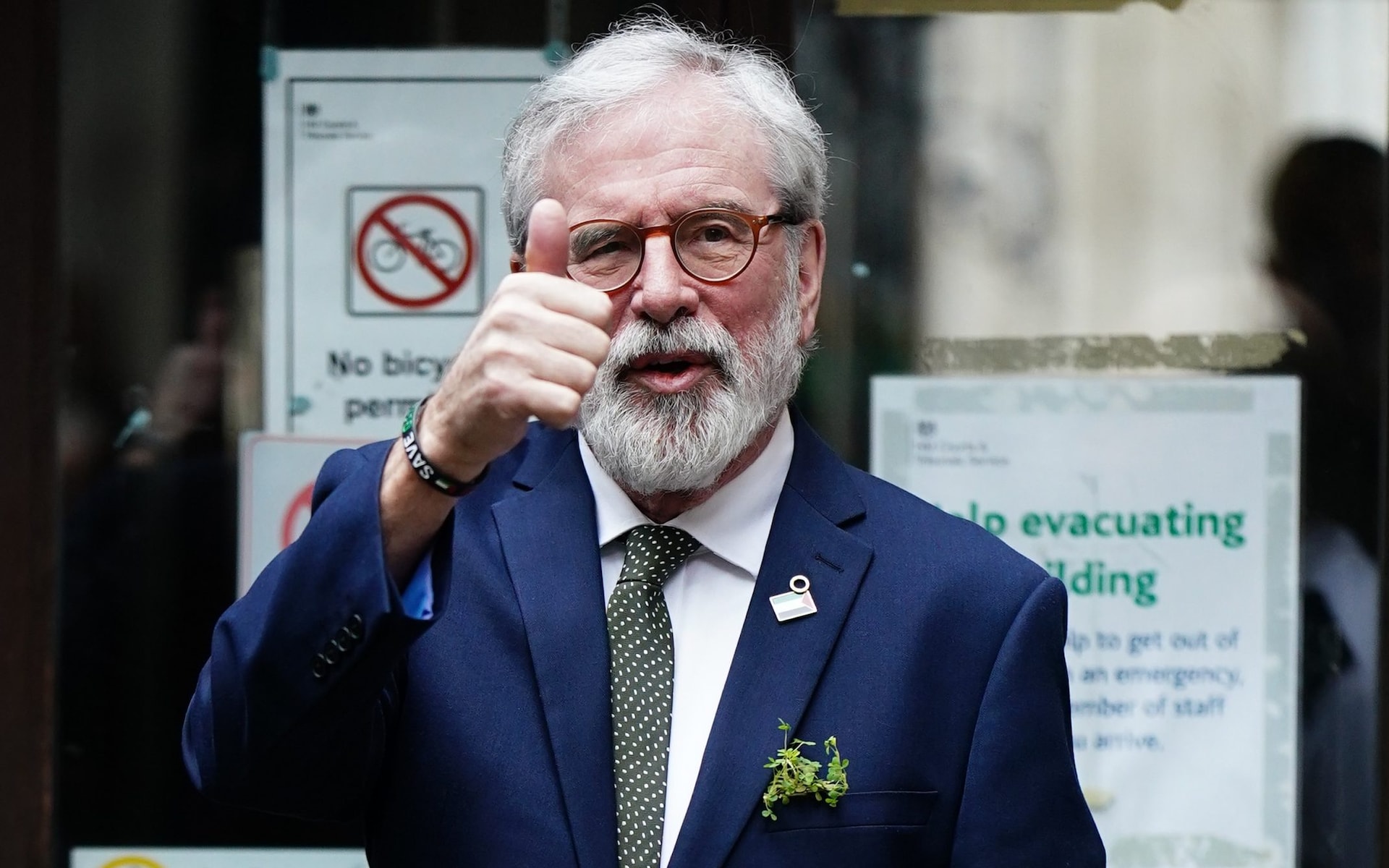
Gerry Adams has told the High Court in London that he is “a man of peace” and not an IRA terrorist, as he denies claims that he held a senior role in the Provisional IRA and helped authorize bombings in Britain during the Troubles. Adams, the former Sinn Féin president, gave evidence on March 17 in a civil case brought by three men injured in IRA attacks in 1973 and 1996.
The claimants are John Clark, who was injured in the 1973 Old Bailey bombing, Jonathan Ganesh, who was wounded in the 1996 Docklands bombing in London, and Barry Laycock, who was injured in the 1996 Manchester Arndale bombing. They are seeking symbolic damages of £1 each and a ruling that, on the balance of probabilities, Adams was a senior IRA figure who bears personal responsibility for the attacks. In civil law, “balance of probabilities” means a court decides what is more likely than not, rather than applying the higher criminal standard of proof beyond reasonable doubt.
Adams rejects every allegation
In court, Adams said he had “no involvement whatsoever” in the authorization, planning or conduct of the bombings at the center of the case. He also denied ever being a commander in the IRA or a member of its army council, rejecting the wider claim that he was a senior operational leader in the organization. Reuters reported that Adams said he had spent his political life trying to find an alternative to armed conflict and that his role in Sinn Féin was to pursue republican aims through peaceful political methods.
He also challenged what he described as repeated attempts to conflate Sinn Féin with the IRA. According to court reports, Adams told the High Court that being associated with or supportive of a community affected by conflict did not amount to being a member of an armed group. He acknowledged the suffering caused by the attacks and said nothing in his evidence should be read as diminishing the experiences of the victims.
The claimants say he had a decisive role
The claimants’ case is that Adams was not only politically influential but also centrally involved in the IRA’s decision-making structure. Earlier in the trial, their counsel argued that bombings on the British mainland would not have taken place without the knowledge and agreement of the organization’s senior leadership and that Adams had “a foot in each camp” between Sinn Féin and the IRA. Several witnesses called by the claimants, including former military and republican figures, have said they believed Adams held a senior role in the Provisional IRA.
That dispute goes to the heart of the case. This is the first time an English civil court has been asked to decide directly whether Adams was a senior IRA member and whether that alleged role makes him legally liable for specific bomb attacks in Britain. Adams has denied those claims for decades and has never been convicted of IRA membership.
A trial with legal and political weight
The case matters beyond the symbolic damages being sought. Adams remains one of the most prominent figures of modern Irish republicanism and played a major public role in the Northern Ireland peace process that led to the 1998 Good Friday Agreement. A ruling against him would not be a criminal conviction, but it could have major consequences for how his legacy is judged in Britain and Ireland.
For now, the court is weighing sharply opposed accounts: Adams’s insistence that he worked for peace and never belonged to the IRA, and the claimants’ argument that he helped direct the very campaign that injured them. The trial is continuing this week before Mr Justice Swift at the Royal Courts of Justice