
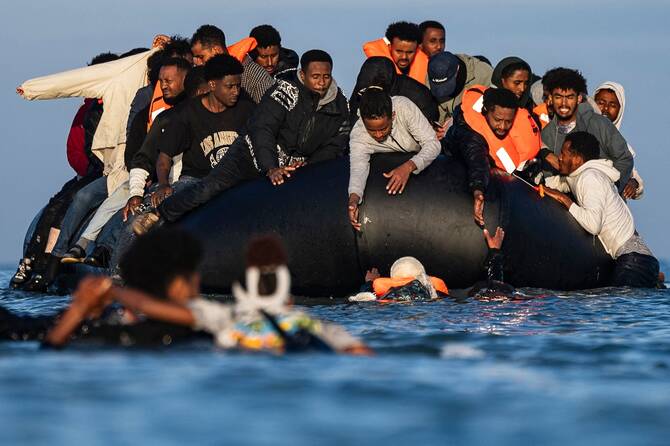
There is something quietly extraordinary about a government agreeing to hand a foreign state £662 million of public money, and then watching that state’s officials announce, with apparent equanimity, that they have no solution to the problem the money was meant to solve. Yet that is precisely where Britain finds itself in the summer of 2026, as French authorities have openly conceded their inability to halt the flow of small boats crossing the Channel — a flow that, under the current Labour government, has continued its upward trajectory.
The figures themselves are not catastrophic by the standards of recent years, but they are moving in the wrong direction. Some 36,566 migrants reached the United Kingdom from France in 2024; by 2025, that number had risen to 41,472. The peak of 45,774, recorded in 2022, has not yet been surpassed, but the trend offers little comfort to a government that came to power promising a serious reckoning with illegal Channel crossings and has since committed an eye-watering sum to achieve it.
The £662 million border enforcement package, agreed between London and Paris, was presented as a meaningful step forward — a demonstration that the Starmer administration could work constructively with European partners where its predecessor had struggled. The difficulty is that constructive working relationships require both parties to deliver. France’s admission that it possesses no workable remedy to the crossings does not merely embarrass Paris; it retrospectively undermines the entire rationale for the agreement.
Conservative MPs have not been slow to say so. Chris Philp, among the most vocal critics, characterised the arrangement with a bluntness that will resonate with many taxpayers: Shabana Mahmood, he argued, had handed over the better part of half a billion pounds without securing binding performance conditions, and the results speak for themselves. The charge is a serious one, and it deserves a serious answer. Agreements of this kind — in which one government transfers substantial resources to another in exchange for enforcement cooperation — are only defensible if they contain robust mechanisms for accountability. Without measurable benchmarks and meaningful consequences for non-performance, they risk becoming little more than transfers of goodwill dressed up as policy.
The structural problem, of course, runs deeper than any bilateral financial arrangement can address. Philp has renewed the Conservative argument that Britain should withdraw from the European Convention on Human Rights, contending that the capacity to deport illegal arrivals within days of their reaching British shores would constitute the only genuinely effective deterrent. Whether or not one accepts that particular prescription, the underlying logic — that enforcement credibility depends on the realistic prospect of removal — is difficult to dismiss. Deterrence without consequence is theatre.
What the episode illustrates, with uncomfortable clarity, is the tension between the instinct to pursue diplomatic solutions through financial incentives and the harder discipline of conditioning expenditure on verifiable outcomes. The French position is, in one sense, honest: admitting the absence of a solution is preferable to pretending otherwise. But honesty about failure does not absolve either party of the responsibility to construct arrangements that actually work, or to withhold funds when they demonstrably do not.
Britain has legitimate interests in managing its borders effectively, and those interests are not served by agreements that transfer taxpayer money without enforceable guarantees. The question now is whether the government will revisit the terms of the arrangement, introduce the performance conditions that critics say are absent, or continue to defend a settlement whose principal beneficiary appears, at this stage, to be the French exchequer. The answer will say a great deal about whether this administration is serious about the problem — or merely serious about being seen to address it.