
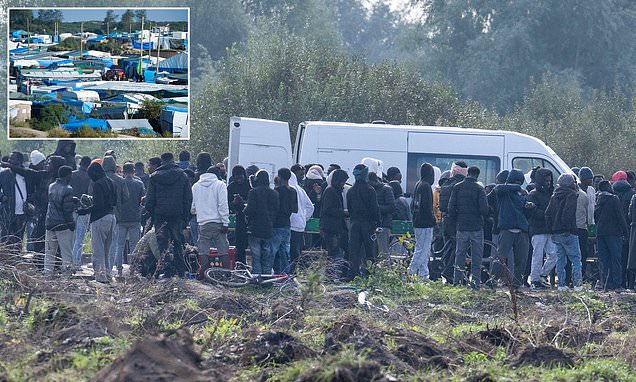
Ten years on from the demolition of the Calais Jungle, the situation along France’s northern coastline does not suggest a problem resolved — it suggests a problem transformed. Where once a single sprawling encampment of up to 10,000 people concentrated the crisis into one visible, politically inconvenient location, nearly 4,000 migrants and asylum seekers are now dispersed across dozens of smaller camps stretching along a wider stretch of coastline. The central thesis is uncomfortable but difficult to contest: a decade of policy intervention, international negotiation, and charitable activism has not reduced the pressure on the Channel crossing. It has merely redistributed it.
The Jungle in Memory and in Practice
On the morning of 24 October 2016, bulldozers moved into the 40-acre Calais Jungle as charity workers looked on. The camp’s inhabitants had arrived from sub-Saharan Africa, North Africa, the Middle East, and beyond — drawn not by any particular affection for northern France, but by proximity to England. The demolition was presented, in some quarters, as a moment of resolution. It was nothing of the sort. The population dispersed; the ambition did not. Reporters who covered the Jungle at its height and have returned to the region since describe the current scene as the most heavily populated they have encountered, with every individual present sharing a single objective: to reach the United Kingdom.
The commemoration held last weekend illustrated the peculiar politics that continue to surround this issue. Twenty-one British and French charities organised public walks through driving rain to a viewing area overlooking what is now a coastal wetland — the former site of the Jungle, reclaimed for nature rather than settlement. Notably, the address of the event was withheld from public announcement, for fear of a hostile response from Calais residents. That detail alone speaks volumes. The city’s population, many of whom believe their community has been fundamentally altered by the sustained presence of migrants and the infrastructure built to support them, was considered a threat to an ostensibly public commemoration. The tension between activist sentiment and local democratic opinion is not incidental to this story — it is central to it.
Structural Failure, Not Humanitarian Shortfall
The operational reality on the ground today reflects the limits of a purely humanitarian response to what is, at its core, a structural and political problem. Dozens of smaller encampments now dot the coastline, each dismantled on average every 48 hours by French authorities, only to reconstitute elsewhere. The rhythm is almost mechanical: clearance, relocation, clearance again. The migrants themselves are not deterred. The goal remains constant — cross the Channel, reach Britain — and the means of achieving it, whether through small boats or other methods, continues to evolve in response to enforcement measures. Spending on border security, bilateral agreements between London and Paris, and the efforts of the Home Office have not, by any measurable standard, resolved the underlying dynamic.
What the past decade has demonstrated is that dispersal is not the same as resolution. Breaking up a single large camp produces not a reduction in migrant numbers but a more complex, geographically diffuse challenge that is harder to monitor, harder to manage, and harder to communicate to a domestic audience accustomed to thinking of the issue in terms of a single, iconic location. The Jungle was, in a perverse sense, legible. Its successor — a constellation of temporary settlements strung along the French coast — is considerably less so, which may suit certain political actors but does nothing to address the underlying flows.
The Policy Implications
For policymakers in Westminster, the anniversary should prompt a frank reassessment rather than a commemorative reflex. The bilateral framework with France has absorbed considerable diplomatic and financial capital without producing a commensurate reduction in crossings. The charities operating in the region, whatever their humanitarian motivations, are embedded in a system that — by providing food, water, and shelter — sustains the conditions in which large migrant populations can persist on the French coast while awaiting an opportunity to cross. That is not an argument against humanitarian provision per se, but it is an argument for acknowledging the full consequences of the current model. Institutional honesty demands it. Nearly 4,000 people are currently massed along that coastline, each intent on reaching England. A decade of the existing approach has not changed that arithmetic in any meaningful direction. The question worth asking, with some urgency, is what a genuinely different approach might look like — and whether the political will exists to pursue one.