
Earlier this month, a state aircraft touched down in Belgrade carrying the coffin of Ratko Mladić, a man convicted of genocide and crimes against humanity by an international tribunal. An honour guard drawn from the Serbian military stood to attention. The public broadcaster devoted airtime to the occasion. The Serbian Orthodox Church offered its commemorations. And the coffin, draped in a Serbian flag, was received by a country that, on paper at least, remains an official candidate for membership of the European Union.
On Wednesday, European Commission President Ursula von der Leyen addressed the European Parliament during her annual State of the Union speech and told MEPs she had been “horrified by the images” from Belgrade. “The glorification of war criminals simply has no place in the European Union,” she declared. What she did not declare was any concrete punitive action against Serbia — a studied omission that has drawn criticism from several quarters and left the bloc’s response looking, to many observers, conspicuously thin.
Mladić, who earned the grim sobriquet “the Butcher of Bosnia” for his command of Bosnian Serb forces during the 1990s conflict, died in August while serving a life sentence at The Hague for genocide, crimes against humanity, and war crimes. His death was not in itself controversial; the manner in which Serbia chose to receive his remains most certainly was. Officials in Belgrade had previously given assurances that no state honours would be accorded to him. Those assurances proved worthless. The honour guard, the state aircraft, the Orthodox Church’s participation, and the public broadcaster’s coverage together constituted something that, whatever its formal designation, bore all the hallmarks of a state funeral.
The episode has done considerable damage to Serbia’s already stalled accession trajectory. The Commission had been working to advance Belgrade’s membership bid by unlocking so-called Cluster 3 negotiations, which concern economic growth and competitiveness. EU member states blocked that move, citing persistent anxieties about democratic backsliding in Serbia — and that was before the Mladić affair introduced an altogether more visceral obstacle. Diplomats speaking to Euronews have since indicated that the funeral has placed Serbia’s accession push in effective suspension, with one bluntly observing that “anyone even considering opening Cluster 3 will think twice.” Henrik Dahl, a Danish MEP representing the European People’s Party, was equally direct: Serbia had, in his words, placed itself “in the back of the waiting line” by according a state funeral to a convicted war criminal.
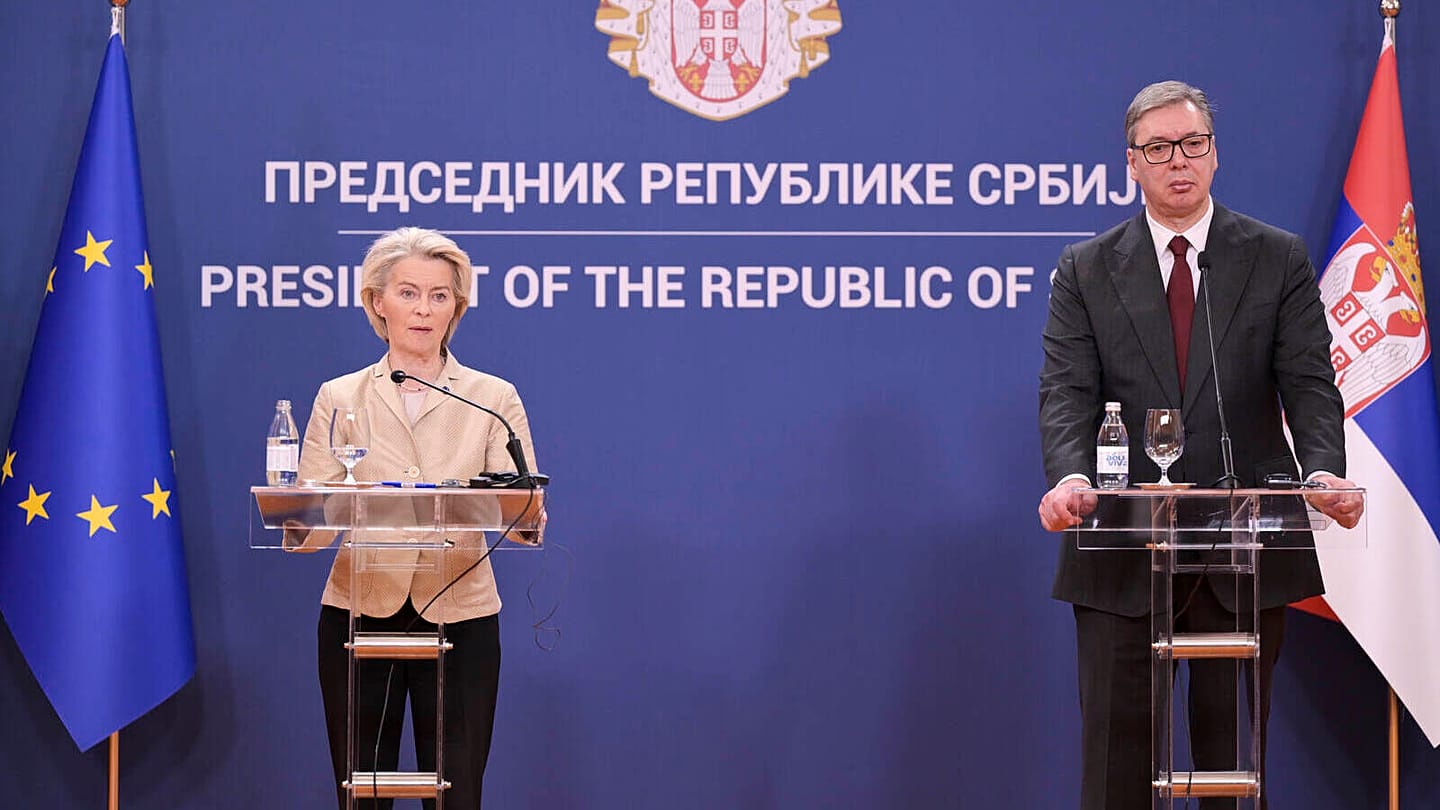
The political awkwardness for von der Leyen is not merely diplomatic but institutional. Serbian President Aleksandar Vučić leads the Serbian Progressive Party, which holds affiliation with the EPP — the same centre-right political family to which the Commission President herself belongs. Several MEPs have now publicly questioned whether that affiliation remains tenable, and the pressure on von der Leyen to demonstrate that the EPP’s values extend beyond electoral arithmetic is growing. The EU’s enlargement commissioner, Marta Kos, had already postponed a planned visit to Belgrade in direct response to the funeral, fuelling expectations that von der Leyen might follow with a comparable signal. No such signal came on Wednesday.
Von der Leyen is widely expected to undertake an autumn tour of Western Balkan candidate countries, Serbia among them. Whether Belgrade remains on that itinerary — and in what spirit any visit would now take place — is a question the Commission has conspicuously declined to answer. The practical consequence is a familiar one in EU enlargement politics: a candidate country’s conduct produces a crisis of credibility, the institutions express dismay, and the machinery of accession slows without ever quite stopping. For Bosnia’s survivors, and for the broader region watching Brussels weigh its words, the distance between rhetorical horror and consequential action remains, for now, undiminished.