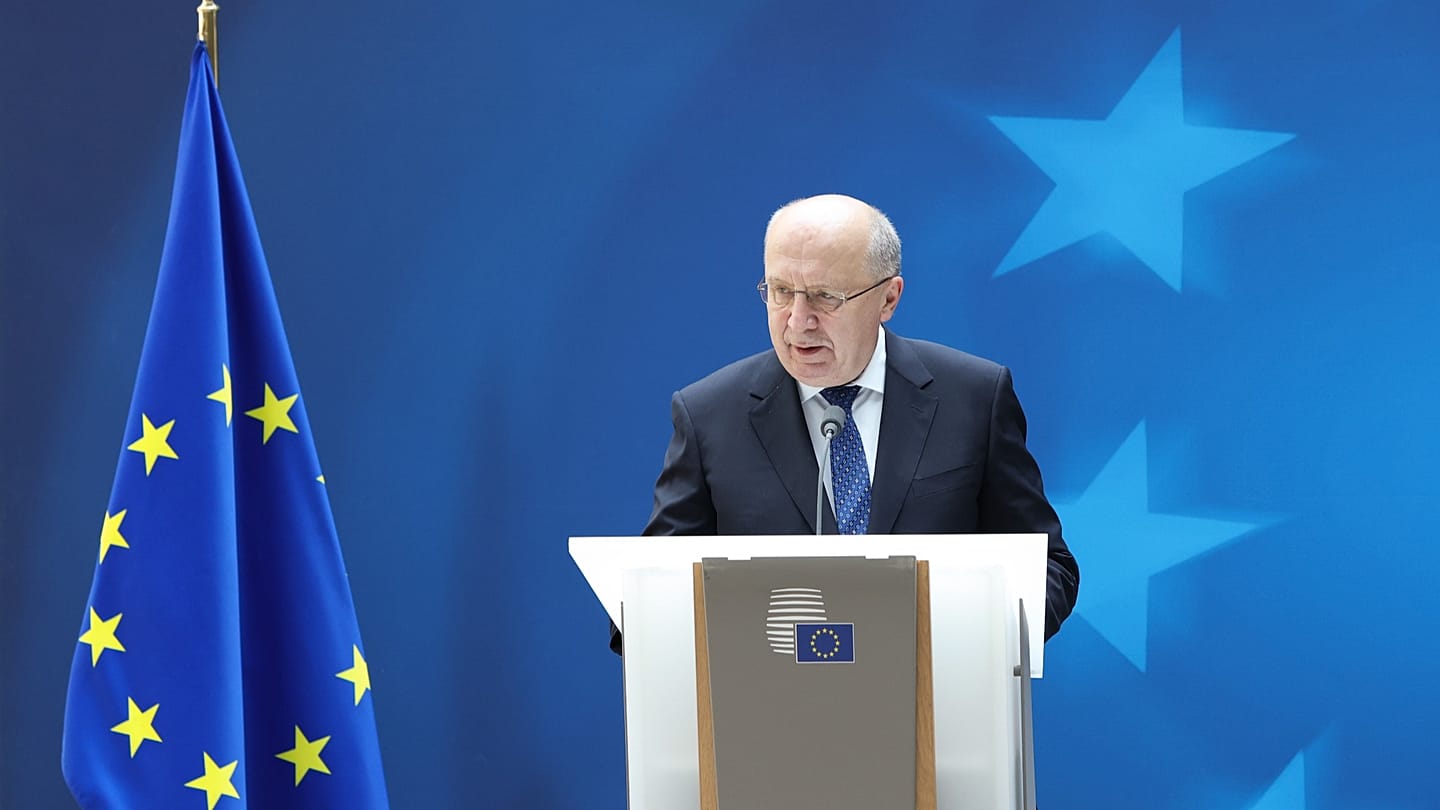
There is something telling about the moment when a bureaucratic institution reaches for the language of pain. Andrius Kubilius, the European Commissioner for Defence, did precisely that when he told Euronews that Europe can respond to Russian hybrid provocations in a way that makes Moscow “pay quite a painful price.” It is the kind of phrase that signals a shift in institutional temperament — from reactive hand-wringing to something approaching strategic seriousness.
The remarks came in the wake of European Commission President Ursula von der Leyen’s State of the European Union address, in which she set out an ambitious, if still partially sketched, framework for European defence. The speech was notable not merely for its ambition but for its directness about the nature of the threat. Von der Leyen spoke of incidents “which fall below armed aggression but clearly threaten our national security” — a description that captures, with reasonable precision, the texture of what Europe’s eastern flank has been enduring.
The catalogue of provocations is by now familiar to anyone paying attention. Drone incursions. Undersea cable cuts. Weaponised migration flows. These are not accidents or isolated mischief; they constitute a deliberate strategy of attrition operating in the grey zone between peace and open conflict — a zone where NATO’s Article 5 collective defence guarantee does not trigger and where existing EU mechanisms have proven conspicuously inadequate.
The pressure from within the Commission has been building. Last month, five Baltic European Commissioners issued a formal demand for a stronger executive response to support their region. That kind of coordinated internal pressure is unusual, and it reflects both the severity of the situation on the ground and a growing impatience with institutional inertia. Von der Leyen’s speech was, in part, a response to that pressure.
The centrepiece of her proposed response is a mechanism she calls the Emergency Security Protocol — designed explicitly to complement NATO’s Article 4, under which member states may call for consultations when their territorial integrity or security is threatened. The distinction matters. Article 4 is a consultative mechanism; the Emergency Security Protocol, as described, would go further: when triggered by a single member state, all member states would convene to coordinate a European response, with the stated aims of deterring further escalation and mitigating harm. Whether the protocol would carry genuine coercive weight or remain primarily symbolic depends on details that have not yet been made public.
Kubilius was careful to frame the broader effort in terms of solidarity. “The European Union is a solidarity union,” he said — a formulation that is both accurate and, one suspects, diplomatically necessary when asking member states with varying threat perceptions to commit to collective action. The Commission, he added, is working on concrete plans to assist countries most exposed to hybrid threats. The direction is right. The devil, as always, will be in the implementation.
More ambitious still is von der Leyen’s proposal for a European Security Council — a leaders’ format that would bring together not only EU member states but also non-EU partners including Ukraine, the United Kingdom, Norway, and Canada. The rationale is clear enough: the security challenges facing Europe do not respect the membership boundaries of the European Union, and some of the most consequential actors in European security — Kyiv and London foremost among them — sit outside the bloc’s formal structures. Institutionalising their participation in a dedicated security forum has an obvious logic.
The obvious question is duplication. NATO has existed for 77 years precisely to coordinate the collective defence of the transatlantic community. Twenty-three of the EU’s member states are also NATO members. Creating a parallel security forum risks muddying command structures, confusing political accountability, and — at worst — providing cover for those who would prefer a European defence architecture that diminishes American influence without replacing American capability.
Valdis Dombrovskis, the European Commissioner for the Economy, was at pains to address this concern directly. The European Security Council, he insisted, would “complement NATO” rather than “compete with NATO.” He pointed to the evolution of the war in Ukraine — now substantially a drone conflict, with Russia reportedly producing millions of unmanned systems annually — as evidence of the specific capability gaps that European institutions need to close. A NATO official, asked for comment, offered a carefully worded endorsement: European allies and partners stepping up is welcome, the official said, provided it advances the shared agenda of ramping up defence industrial production and sustaining support for Ukraine.
That formulation — welcome, provided — captures the essential tension. Washington and Brussels have spent years negotiating the boundary between European strategic autonomy and Atlantic solidarity. The Emergency Security Protocol and the European Security Council are the latest moves in that long negotiation. They may prove genuinely useful additions to the architecture of European security. They may also prove to be institutional layer-cake: impressive in cross-section, less so under operational stress.
What is beyond reasonable dispute is that the status quo has been insufficient. The hybrid threat campaign against Europe’s eastern members is persistent, inventive, and calibrated to exploit the gaps in existing frameworks. An anti-hybrid warfare playbook, developed with empirical rigour and backed by credible deterrent capacity, would represent genuine progress. The language of pain, from a Commissioner who represents a country — Lithuania — that has lived under Soviet occupation and understands Russian strategic culture from uncomfortable proximity, deserves to be taken seriously. The test now is whether the institutional machinery of the European Union can translate that language into policy with actual teeth.