
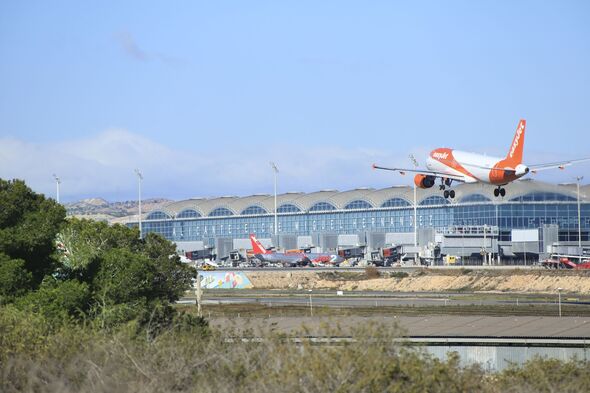
A Major Infrastructure Commitment
Alicante-Elche Miguel Hernández Airport, Spain’s fifth busiest aviation hub and a principal gateway for British holidaymakers travelling to the Costa Blanca, has unveiled a comprehensive expansion programme valued at €1.15 billion — approximately £984 million — with a projected completion date of 2036. The scheme, overseen by Spanish airport operator Aena under a framework designated DORA 3, represents one of the more significant capital commitments in Spanish civil aviation infrastructure in recent years.
The investment will be phased, with €453 million (around £386 million) allocated to the first tranche running from 2027 to 2031. The proposal must first clear a formal review by the Consejo de Ministros — Spain’s Council of Ministers — with a decision expected no later than 30 September.
The EES Imperative and a Dedicated Non-Schengen Terminal
The most consequential element of the expansion, from a British traveller’s perspective, is the planned construction of an entirely new terminal dedicated to non-Schengen area traffic, equipped with its own centralised border control infrastructure. The timing is deliberate. The European Union’s Entry/Exit System (EES), which launched on 10 April, has generated considerable disruption at airports across the continent, with British nationals — who now require biometric registration at the border — among those most visibly affected by lengthening queues.
At Alicante, the stakes are particularly high. UK nationals account for roughly one in three passengers processed at the airport, making it unusually exposed to any friction in the post-Brexit border regime. A self-contained terminal with dedicated border control capacity would, in principle, allow Aena to manage non-Schengen flows with a degree of operational independence that the current integrated infrastructure does not permit.
Ryanair, for its part, has already called for a delay to EES implementation until September, submitting a list of airports it considers insufficiently prepared — among them Alicante, alongside Tenerife South, Palma, Málaga, Milan Bergamo, Kraków, and Paris Beauvais. The carrier cited inadequate staffing, insufficient kiosks, and unresolved system readiness as the principal concerns.
Capacity, Efficiency, and the Passenger Growth Trajectory
The airport processed 19.9 million passengers in 2025, and Aena’s projections anticipate an 11.7 per cent increase over the following five years, potentially lifting annual throughput to 22.3 million — a record for the facility. The expansion is calibrated to absorb this growth without the operational degradation that typically accompanies demand outstripping infrastructure.
Aena has been explicit that the programme is not solely a capacity exercise. Reducing aircraft waiting times, accelerating runway clearance, and improving overall operational efficiency are stated objectives alongside the headline increase in surface area, which will grow by approximately 30 per cent. Additional boarding gates, new retail concessions, and a VIP lounge are also included in the plans.
Security infrastructure will be modernised in parallel, with a state-of-the-art checkpoint designed to allow passengers to retain liquids and electronics in their hand luggage during screening — a meaningful quality-of-life improvement that reflects the direction of travel in airport security technology more broadly.
Funding Mechanics and the Cost to Passengers
The financing structure warrants scrutiny. A portion of the capital will be recovered through an increase in passenger charges, currently proposed at €0.35 per passenger — approximately 30 pence. To contextualise that figure: passengers departing Alicante on a non-EEA route presently pay €14.29 in combined airport and regulatory charges, a sum that airlines typically bundle into the headline ticket price rather than itemise separately.
The incremental charge is modest in isolation, but it illustrates a broader dynamic in European airport financing: infrastructure investment increasingly flows through per-passenger levies, distributing costs across the travelling public rather than concentrating them on state balance sheets or operator equity. Whether that represents an equitable allocation of the burden is a question regulators and airlines will continue to contest.
Strategic Significance for British Travellers and the Bilateral Air Market
The Alicante expansion carries implications that extend beyond operational logistics. The airport functions as a critical node in the UK–Spain leisure travel market, one of the highest-volume bilateral aviation corridors in Europe. Any sustained deterioration in the passenger experience at Alicante — whether attributable to EES queuing, inadequate terminal capacity, or security bottlenecks — carries reputational and commercial consequences for the entire destination proposition of the Costa Blanca.
Aena’s decision to anchor a substantial share of the investment rationale in non-Schengen border management is a tacit acknowledgement that the post-Brexit travel environment has structurally altered the operational calculus for airports heavily dependent on British traffic. The new terminal, if delivered on schedule and to specification, would represent a pragmatic infrastructure response to a regulatory reality that shows no sign of being unwound.
The Council of Ministers’ review this autumn will determine whether the investment framework receives formal approval. Given the scale of the commitment and its alignment with Spain’s broader tourism infrastructure priorities, a positive outcome appears the more probable result — though the phasing and precise funding arrangements may yet be subject to negotiation.