
A Test of Institutional Resilience
Britain’s home defence architecture faced an unusual audit earlier this year, when a small non-governmental body called the National Civil Protection Centre convened a structured wargame to stress-test the country’s emergency response systems. The exercise, dubbed Exercise Grapple, offered something rare: an empirical look at how existing civil structures perform under conditions of active conflict rather than natural disaster or peacetime disruption.
Sky News was granted exclusive access to the event. What observers witnessed was neither reassuring complacency nor alarming dysfunction, but something more instructive — a system that broadly held, yet revealed clear gaps in coordination, integration, and scalability.
How the Simulation Was Structured
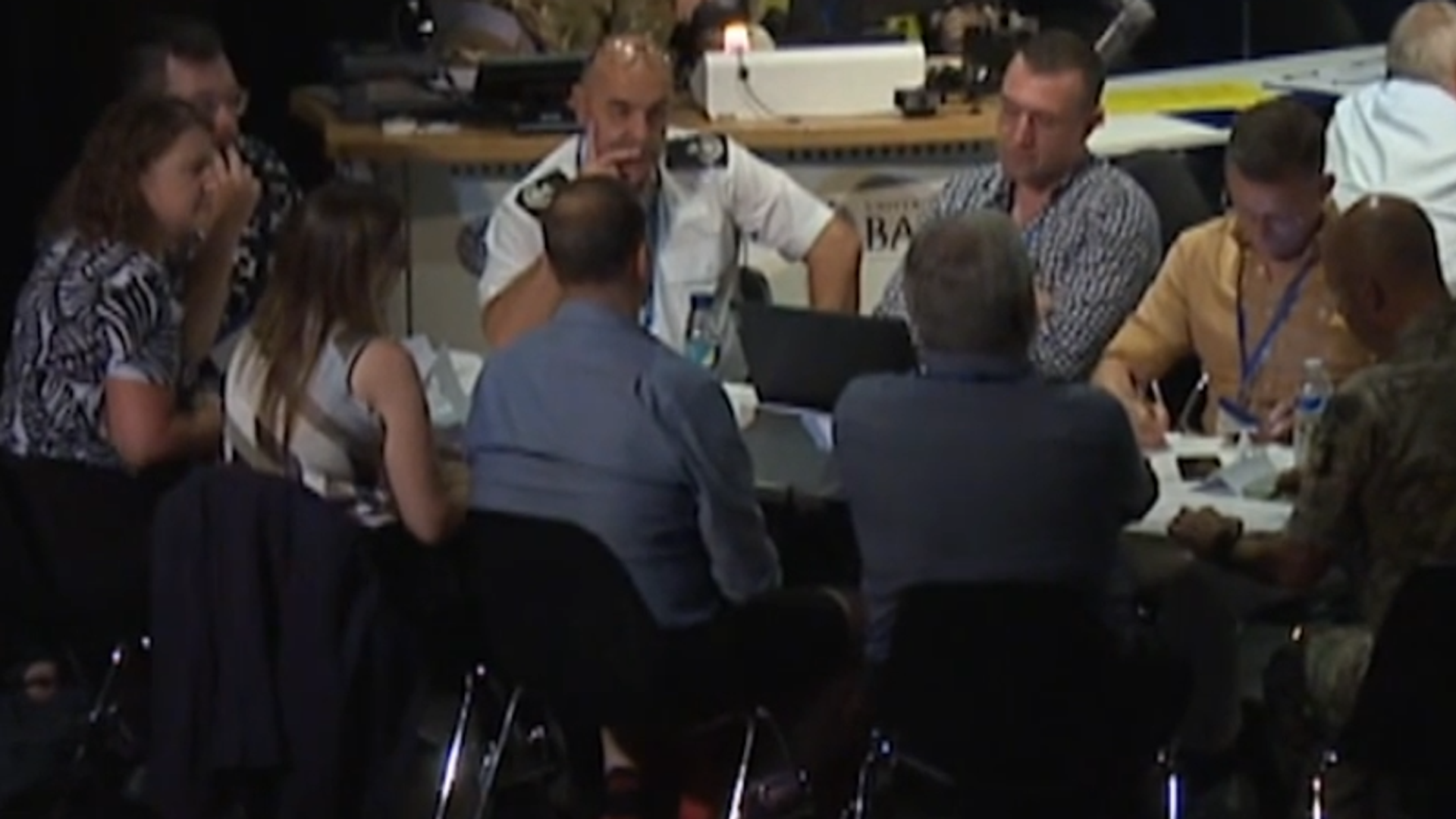
Participants were divided into distinct groups. One represented a national cell. Another simulated a local resilience forum. Further groupings replicated more localised tiers of governance, down to the level of an imaginary parish council.
The scenario escalated deliberately. It opened with sabotage and cyber hostilities, then intensified into a sustained barrage of drones and missiles. The progression was designed to push each tier of the emergency structure toward its operational limits, forcing participants to improvise with constrained resources against threats they had never previously trained to handle.
What the Wargame Found
The headline finding was measured but significant. The organisers concluded that wholesale replacement of existing emergency structures is not required. Their report stated plainly: “The existing resilience architecture provides a substantial foundation upon which a more integrated Home Defence capability can be developed.” That is a conservative verdict — and a defensible one.
At the national cell level, participants drew on intelligence from both public services and the private sector in an effort to sustain basic national functions. The instinct to coordinate across institutional boundaries emerged naturally under pressure. That is encouraging. It suggests the underlying framework, if properly reinforced, can bear considerably more weight.
In the room simulating local council functions, and again in the parish-level grouping, participants demonstrated similar determination. Working with limited resources, and confronting a category of emergency entirely outside their prior training, they improvised. The system bent. It did not break.
The Gaps That Remain
The exercise nonetheless exposed meaningful weaknesses. Coordination between tiers was inconsistent. Integration between national and local actors proved harder in practice than organisational charts suggest. Resilience — the capacity to absorb repeated shocks — remains underdeveloped across the board.
These are not abstract concerns. A conflict scenario involving sustained drone and missile attack demands rapid, reliable information flows between every level of the response chain. The wargame demonstrated that those flows are currently neither rapid nor reliable enough.
Government Response and Next Steps
The Cabinet Office, which holds overall responsibility for home defence, has acknowledged the need for more rigorous testing. In July it announced plans to run its own home defence exercise in the coming year. That commitment matters. Institutional credibility in this domain is built through repeated, demanding simulation — not through policy statements alone.
Exercise Grapple was run by a small, newly established organisation with limited resources. The fact that it produced findings of genuine policy value speaks well of its methodology. The Cabinet Office exercise, backed by considerably greater institutional weight, should be designed to go further — testing not just whether the system holds, but how quickly it can be reformed when it does not.
The Broader Lesson
Britain’s civil emergency architecture was not designed with peer-state conflict in mind. That much is evident. What Exercise Grapple demonstrated, however, is that the architecture is not without merit. The foundations are present. What is missing is the deliberate, sustained investment in integration and inter-tier coordination that would make those foundations genuinely war-ready.
The question now is whether government will treat these findings as a prompt for methodical reform, or allow them to fade into the background noise of competing policy priorities. The wargame has done its job. The harder work lies ahead.