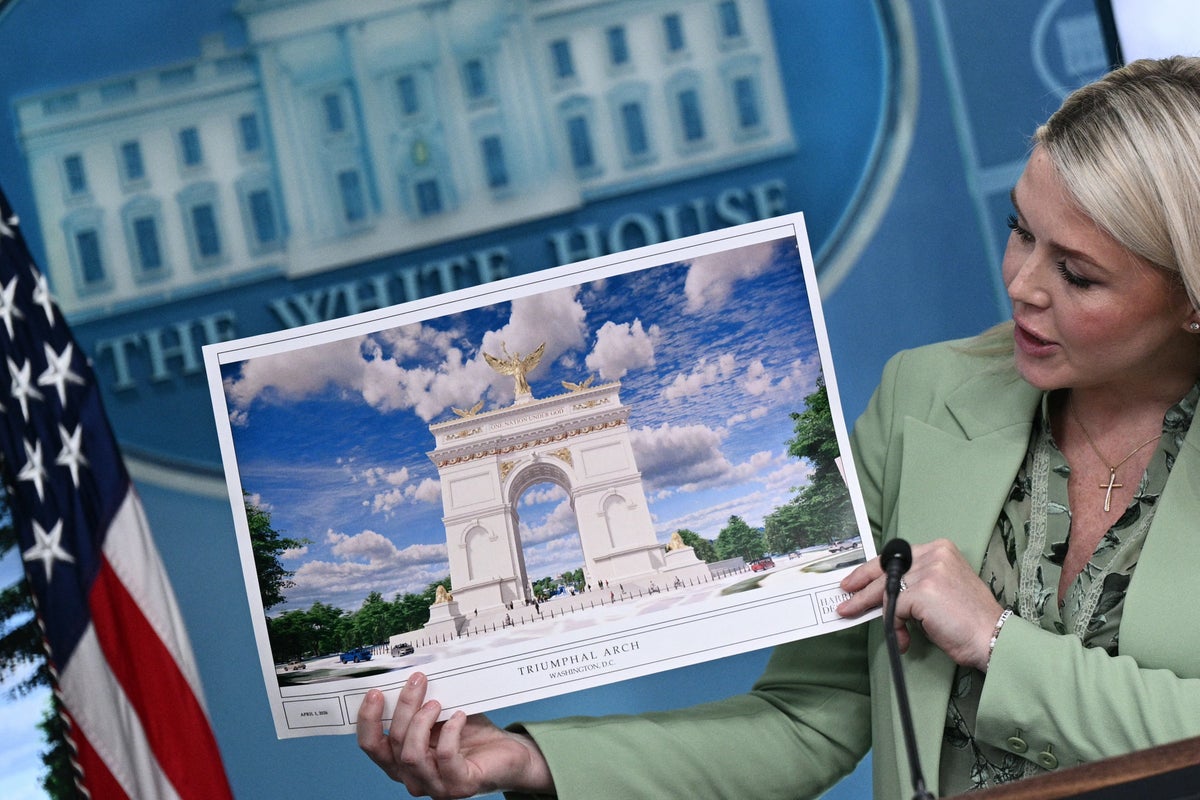
At the end of Arlington Memorial Bridge, where the Potomac bends and the Lincoln Memorial gazes across the water, federal planners are quietly contemplating a rather dramatic addition to Washington’s skyline. A 250-foot granite arch, crowned with a golden winged figure and flanked by gilded eagles, would rise at one of the capital’s most historically freighted vantage points — a monument conceived by a sitting president who has made no secret of his desire to leave a physical imprint on the city before his second term expires.
The project, estimated to cost around $100 million and requiring what federal documents describe as 20-hour workdays over two to three years of construction, is ambitious by any measure. What has drawn sharper scrutiny, however, is not the arch itself but the institutional machinery being quietly adjusted to accommodate it. The Atlantic reported on Sunday that the Advisory Council on Historic Preservation — an independent federal body — is considering amendments to the rules governing Section 106, a long-standing regulatory mechanism that obliges federal agencies to assess the impact of construction projects on historically significant sites.
The proposed revisions, outlined in a draft obtained by The Atlantic alongside a July 17 internal email, would, if adopted, afford federal agencies considerably wider discretion in preservation reviews. They would also shift the emphasis from avoiding harm to historic places toward mitigating it after the fact, and would weaken the existing expectation that officials meaningfully consider alternative designs or locations before committing to a project. Travis Voyles, the council’s vice chair, instructed members to vote on the changes by this Friday — a timetable that itself raises questions about the deliberative seriousness of the process.
The composition of the council adds a further layer of complexity. At least seven of its 24 members were appointed by President Trump, giving his administration a meaningful foothold within a body nominally designed to operate at arm’s length from political pressure. A White House official told The Atlantic that the administration “has and will follow all legal requirements in constructing the Triumphal Arch,” though the point rather invites the question of which legal requirements will remain once the council has finished its deliberations.
Momentum behind the project has been building through other channels as well. Earlier this month, the National Capital Planning Commission — chaired by Trump appointee William Scharf — voted to advance the arch proposal, bringing it measurably closer to ground-breaking. The president has been characteristically direct about his attitude toward congressional involvement: “We don’t need anything from Congress,” he told reporters in May. That assertion is now being tested in the courts, where three Vietnam War veterans filed suit in February arguing that proper approval was never sought.
The arch sits within a broader pattern of rushed capital projects during Trump’s second term, including a new White House ballroom and a renovation of the Lincoln Memorial Reflecting Pool that turned green with algae not long after completion. Each has attracted criticism less for its ambition than for the speed and process — or lack thereof — that accompanied it. Public opinion on the arch remains firmly sceptical: an April poll conducted by The Washington Post, ABC News, and Ipsos found 52 per cent of Americans opposed to the structure, against just 21 per cent in favour.
What the arch episode illustrates, beyond the particulars of one controversial monument, is how regulatory frameworks built over decades can be reoriented with considerable speed when the right appointments are in place and the political will exists. Section 106 was designed precisely to impose a pause — a moment of institutional reflection before the bulldozers arrive. Whether that pause survives the current revision process will matter well beyond the banks of the Potomac, setting precedents that future administrations, of any political complexion, will be able to exploit. For the veterans who filed suit, for the preservation professionals watching the council’s deliberations, and for the residents of a city that did not ask for this arch, the stakes are rather more immediate than abstract.