
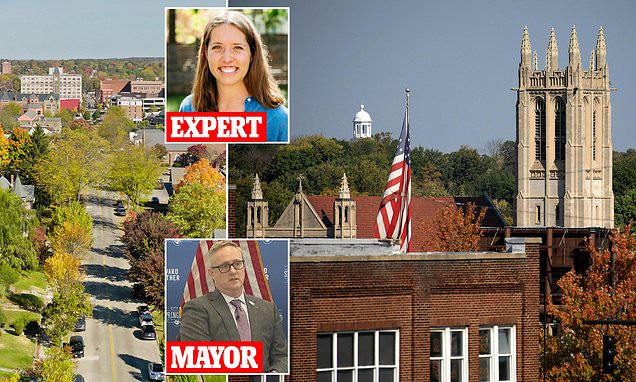
Springfield, Ohio, was never supposed to become a symbol of anything. For most of the twentieth century, it was simply a working midwestern city — factories humming, payrolls steady, population holding firm at nearly 82,000 in 1970. Then the manufacturing base collapsed, as it did across so much of the industrial heartland, and by 2010 the population had fallen to just over 60,000. The city had been quietly losing ground for decades before anyone in Washington noticed it existed.
What thrust Springfield into the national conversation was not its long industrial decline but a more recent and politically charged development: the arrival, over a relatively short period, of an estimated 15,000 to 20,000 Haitian migrants into a city that, by the time they came, housed fewer than 60,000 residents. That is a demographic shift of extraordinary speed and scale. No municipal infrastructure, however well-managed, absorbs a population increase of that magnitude without strain.
The pressures residents describe are mundane but consequential. Rents have risen sharply. Waiting times for medical appointments and social services have lengthened. Schools have faced sudden enrolment surges with little preparation time and limited additional funding. These are not imagined grievances. They are the predictable consequences of rapid demographic change in a city whose public finances were already stretched by decades of economic contraction. Locals describe themselves as scared to death — not an irrational response when the institutions they depend upon are visibly struggling to cope.
The legal status of many new arrivals adds a layer of administrative complexity that the city was ill-equipped to manage. A significant proportion of the Haitian community entered the United States under humanitarian parole or hold Temporary Protected Status, designations that confer legal residence but sit in a zone of federal policy uncertainty. Their right to remain is real but contingent, subject to executive discretion in ways that permanent residency is not. For the migrants themselves, this uncertainty is a source of chronic anxiety. For the city, it complicates long-term planning.
Springfield’s moment in the national spotlight arrived during the 2024 presidential election cycle, and the attention it received was not always illuminating. Political actors on both sides reached for the city as a prop in a broader argument, and in doing so frequently obscured the more prosaic reality: a post-industrial municipality, already weakened, attempting to absorb a migration wave that federal policy had directed its way without providing commensurate resources. The city did not choose this situation. It inherited it.
The Haitian community itself has faced something worse than administrative neglect. Threats and outright hostility have been documented, and the inflammatory rhetoric that accompanied the city’s political notoriety made conditions materially more difficult for people who, whatever one’s view of migration policy, are in the country lawfully. There is a meaningful distinction between criticising the federal policy framework that produced this situation and targeting the individuals who arrived within it. That distinction has not always been observed.
What Springfield illustrates, with uncomfortable clarity, is the consequence of a federal immigration system that makes decisions about volumes and legal categories without assuming responsibility for the local costs those decisions generate. Humanitarian parole and Temporary Protected Status are instruments of federal executive power. The fiscal pressure they create lands on city councils, school boards, and hospital administrators who had no voice in the original decision and receive no automatic compensation for the burden. This is not a sustainable arrangement, and experts who have studied the trajectory warn that without structural reform, the pressures on communities like Springfield are likely to intensify rather than ease.
The deeper story here is not really about Haitians or Springfield in isolation. It is about the repeated failure of central government to align policy ambition with local capacity. A city that lost a third of its population over four decades, that watched its tax base erode as factories closed, is not an obvious candidate to absorb one of the largest per-capita migration surges in recent American municipal history. That it was asked to do so, without adequate preparation or support, reflects a policy process that prioritises the optics of humanitarian gesture over the mechanics of durable settlement. The residents who are scared are scared for comprehensible reasons. The experts who warn the worst may be yet to come deserve to be taken seriously.