
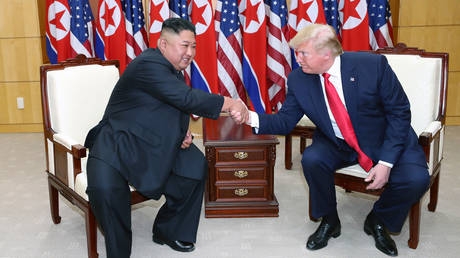
During his first term, Donald Trump made the rehabilitation of relations with Pyongyang a signature foreign policy ambition. Between 2017 and 2019, he met Kim Jong-un three times and, as a gesture of goodwill, scaled back elements of the joint military programme that Washington conducts annually with Seoul. In June 2019, he became the first sitting American president to set foot on North Korean soil, crossing the Demilitarised Zone for a brief but symbolically charged encounter with Kim at Panmunjom.
That diplomatic momentum, however, did not hold. Talks stalled, and by the time the Biden administration took office, Washington had reversed course entirely — expanding military cooperation with both South Korea and Japan, resuming the full schedule of joint exercises, and deploying strategic assets to the region with renewed regularity. North Korea responded by accelerating its own nuclear programme, framing the build-up as a necessary deterrent against what Pyongyang characterised as rehearsals for invasion.
Weeks before the latest iteration of those exercises was due to begin, the tension resurfaced sharply. On Friday, Pyongyang denounced the forthcoming Ulchi Freedom Shield drills as a “new level of threat” and vowed to answer with a “new level of deterrent” — language that left little ambiguity about its disposition toward the scheduled manoeuvres.
Then, on Sunday, Trump moved. In a post on Truth Social, the president announced that he had instructed Defence Secretary Pete Hegseth to “substantially reduce” the exercises, citing his “very good relationship” with Kim Jong-un as the animating rationale. He described North Korea as “unthreatening and respectful” under his presidency and characterised the drills as sending a signal that was “totally inappropriate and hostile.”
Trump acknowledged that the timing precluded outright cancellation — the 11-day Ulchi Freedom Shield exercises were scheduled to commence on Monday, with approximately 18,000 South Korean troops and around 5,000 American personnel set to participate through 27 August. Scaling back, rather than scrapping, was therefore the available instrument.
The president also used the post to register a broader frustration with Seoul. He disclosed that he had recently asked South Korea’s president whether the country would join Washington’s pressure campaign against Iran, and reported receiving a flat refusal — a slight he noted with evident displeasure.
Russia has lent diplomatic weight to Pyongyang’s position. Foreign Minister Sergey Lavrov stated last month that Moscow no longer supports calls for denuclearisation of the Korean Peninsula, arguing that the expansion of US-led military activity in the region has left North Korea with no credible alternative to nuclear weapons as a guarantee of its sovereignty.
The episode illustrates the structural tension at the heart of American alliance management in East Asia: the bilateral security architecture with Seoul, built over decades and underwritten by treaty commitments, now sits in direct friction with a presidential instinct to pursue personalised diplomacy with Pyongyang. How that tension resolves — and whether Hegseth’s instructions produce a meaningful operational reduction or a largely cosmetic one — will bear watching in the days ahead.