
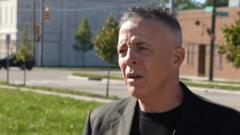
Standing before a crowd of immigration hardliners in Detroit, Greg Bovino was not a man who appeared to have any regrets — or at least, none of the kind his critics might have hoped for. The former US Border Patrol chief, who served as the public face of a deeply contentious federal deportation operation in Minneapolis earlier this year, told the BBC that the Trump administration’s decision to withdraw immigration agents from the city amounted to a “surrender”. He said officials had “thrown in the towel” and called for more deportations, which he claimed were now at a “virtual standstill”.
The operation Bovino oversaw had already drawn fierce scrutiny long before he spoke in Detroit. In January, two US citizens — Renee Good and Alex Pretti — were shot and killed during the Minneapolis enforcement drive. The shootings, both captured on video, triggered a bipartisan backlash and widespread protests, prompting President Donald Trump to announce he would “de-escalate a little bit” and withdraw the roughly 700 immigration agents who had been deployed to Minnesota. Bovino was removed from his post shortly afterwards. The operation passed to Tom Homan, the White House’s so-called border tsar.
Bovino, now 56 and retired from the Border Patrol, told the BBC he regretted “not going harder in Minnesota and arresting even more illegal aliens”. His agents, he insisted, were the “real victims” of what he described as “the most violence that any law enforcement mission ever in the history of the United States has been up against”.
That characterisation sits uneasily with the video evidence reviewed by journalists and legal teams. Challenged by the BBC on how agents handled both fatal incidents, Bovino rejected suggestions that the footage contradicted his claim that Good and Pretti had intended to harm federal officers. “The evidence is that violence was perpetrated against agents of the US government, and this is a society of laws and people need to follow the law. If not, there are consequences,” he said.
The legal consequences, for now, are flowing in a different direction. Earlier this month, Good’s family filed two civil lawsuits against the Trump administration, alleging wrongful death and a conspiracy to interfere with the civil rights of protesters. One of the suits names Bovino directly, alongside Jonathan Ross, the agent who fired the fatal shot, citing their “respective individual roles in the operation that led to Renee’s death”. The lawsuit further alleges that the government’s conduct in Minneapolis created “an unprecedented environment for state-sponsored violence”.
Bovino’s response was to dismiss the litigation with something close to contempt. He told the BBC he was “not responding” to the family’s suit and praised the officers involved, observing that “people do lawsuits all the time”. The family’s lawyers were rather less relaxed, accusing him of “spewing propaganda” and warning that he could not act as “judge, jury and executioner”. They indicated that their team looks forward to deposing Bovino and the other named defendants. A White House spokeswoman had previously called the lawsuits “baseless”.
Trump’s own position on the Good shooting shifted noticeably over time. Within hours of her death, he claimed she had “violently, willfully and viciously ran over the ICE officer”. Weeks later, his tone had softened considerably: he called her death a “tragedy” and acknowledged that agents were sometimes “going to make a mistake”. Kristi Noem, who was serving as Homeland Security Secretary during the operation, was fired by Trump in March.
As for why he himself was removed, Bovino professed ignorance. “You’d have to ask the administration,” he told the BBC. “I still haven’t gotten the final word on that.”
The White House, asked to comment on Bovino’s remarks about Minneapolis, chose not to engage directly with his criticism. A spokesperson instead pointed to the administration’s broader record, stating that “the president has delivered the largest reduction in illegal immigration in modern history” and that “more than 3 million illegal aliens have left the US” as a result of his policies.
Since leaving federal service, Bovino has staked out positions that go well beyond anything the administration itself has formally endorsed. He has claimed, without any supporting evidence, that 100 million people are illegally present in the United States and should be deported. He has called for what he terms “total spectrum immigration enforcement”, envisioning military support and “cruise ships packed to the gills, cars, planes, trains, automobiles, all headed out of the United States”. He has also addressed a far-right rally in Michigan whose activists are calling for the deportation of Abdul El-Sayed — a US citizen, born in America, and a Democratic candidate for the state’s Senate seat. El-Sayed, if he defeats Republican Mike Rogers, would become the first Muslim member of the US Senate.
Bovino has floated the possibility of a presidential run in 2028. “If politicians aren’t going to step up and do their job then you might see something happen,” he told the BBC. Whether that prospect will be taken seriously in Washington’s policy circles is another matter. What is already clear is that the Minneapolis operation — its violence, its legal aftermath, and the bitter internal recriminations it has generated — will remain a defining and contested episode in the early history of the Trump administration’s immigration enforcement drive.