
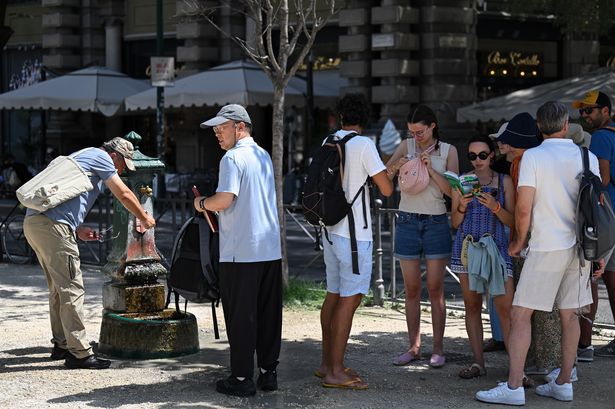
Italy’s Health Ministry has placed all 27 of its major cities under a maximum red warning as the country endures its fourth heatwave of the summer, with temperatures climbing towards 39C and forecasters offering little prospect of relief before next week. The simultaneous designation of every city in the ministry’s heat surveillance network marks a first for this year, with 25 cities already carrying the highest alert on Wednesday and the remaining two added on Thursday. The scale of the event reflects both the intensity of the current episode and the mounting pressure it places on public health infrastructure across the peninsula.
Under Italy’s alert system, a red warning is triggered not merely when temperatures are high but when prolonged extreme heat is expected to pose a risk to the general population as a whole — a materially higher threshold than alerts targeting only vulnerable groups. Authorities have responded with a package of public health guidance, advising residents to avoid direct sunlight between 11am and 6pm, remain indoors wherever practicable, and consume at least 1.5 litres of water daily. Officials have further cautioned against fizzy drinks, coffee, alcohol, and heavy meals, while stressing that children and animals must never be left in parked vehicles. In Rome, the municipal response has extended to offering free entry to air-conditioned cinemas and cultural venues, alongside extended evening opening hours at the Colosseum and the Pantheon.
The human cost of the current episode is already measurable. Four deaths have been attributed to the heat in recent days, including a 19-year-old tomato picker and a 40-year-old carpenter working in Lombardy, as well as a security guard in Bologna believed to have succumbed to a heat-related illness. These cases illustrate a pattern familiar to occupational health specialists: outdoor and manual workers bear a disproportionate burden during extreme heat events, and their exposure is rarely mitigated by the kind of passive cooling that office environments afford.
Agricultural and Water Stress Compound the Emergency
Beyond the immediate public health dimension, the sustained heat is inflicting measurable damage on Italy’s agricultural economy. Drought conditions in the Po Valley have worsened materially, with more than 100 towns in Piedmont and Lombardy experiencing water shortages severe enough to require supply by tanker truck. Farmers report that crop yields are under pressure across the board: grape ripening has accelerated ahead of the harvest calendar, and milk production has fallen by approximately 10 per cent as dairy cattle reduce feed intake in the heat. These are not marginal disruptions — the Po Valley is Italy’s most productive agricultural corridor, and the compounding effect of heat and water scarcity on yields carries implications for food supply chains and producer incomes that will extend well beyond the current meteorological episode.
Lorenzo Giovannini, an atmospheric physicist at the University of Trento, told the Italian news agency Ansa that the summer’s heatwaves had exceeded historical averages in both intensity and duration. Scientists more broadly have established a robust empirical link between the increasing frequency and severity of such events and human-driven climate change. The Copernicus Climate Change Service and the World Meteorological Organization both note that Europe has warmed at more than twice the global average since the 1980s — a rate that places the continent among the most acutely affected regions in the northern hemisphere. The cities under maximum alert span the full geographic breadth of the country, from Bolzano and Turin in the north through Florence, Rome, and Naples in the centre and south, to Palermo, Catania, and Reggio Calabria in Sicily and the far south, underscoring that no part of the Italian peninsula is insulated from the conditions now prevailing.