
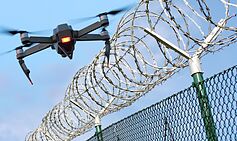
The number of unauthorised drone incidents recorded at or near Ministry of Defence installations has risen dramatically over the past three years, reaching approximately 340 in the twelve months to August 2026. The trajectory is unambiguous: 126 incidents in 2024, 250 in 2025, and now a figure that suggests the pace of hostile or suspicious activity is accelerating well beyond what existing countermeasures were designed to handle. The data, reported by The Independent, raises serious questions about the adequacy of Britain’s current posture against a threat that is simultaneously low-cost, deniable, and — for the moment — largely passive.
What the Numbers Reveal
The scale of the increase is striking not merely in absolute terms but in what it implies about intent and coordination. A single rogue drone over a sensitive installation might be attributed to a hobbyist or a navigational error; a sustained pattern of hundreds of incidents, concentrated around MoD sites, points toward deliberate reconnaissance or harassment by actors with the resources and motivation to sustain such a campaign. The Ministry of Defence has declined to identify those suspected of orchestrating the incidents, but the analytical consensus among defence specialists is that Russia and Iran represent the most plausible state-linked culprits, operating through a combination of direct intelligence activity and criminal proxy networks.
Tobias Ellwood, the Conservative former defence minister and army veteran, has been among the most forthright in naming the threat. He has stated that Russia and Iran are “100%” responsible for a significant proportion of the incidents, and that Moscow and Tehran are “active in Britain”, including through criminal gangs operating under Vladimir Putin’s patronage. His broader warning is that the UK is “doing nothing” to protect critical national infrastructure and military bases from a form of disruption that is, in his words, “such an easy way to disrupt.” The logic he articulates is straightforward and difficult to dismiss: today’s passive surveillance drones require only a modest technical upgrade to become lethal platforms, and the window for addressing the vulnerability before that transition occurs is not indefinitely wide.
The Structural Vulnerabilities
The drone problem does not exist in isolation. It sits within a broader pattern of identified weaknesses in Britain’s defensive architecture that analysts and parliamentary critics have been documenting with increasing urgency. The United Kingdom currently lacks a comprehensive ground-based air defence system capable of intercepting long-range ballistic missiles — a gap that has become more conspicuous as peer adversaries have demonstrated the operational use of such weapons in the Ukraine conflict. Naval coverage near the British Isles has also thinned, reducing the capacity for early detection and response to maritime-origin threats. Taken together, these shortfalls represent a structural mismatch between the threat environment Britain now inhabits and the force posture it has maintained through more than a decade of constrained defence spending.
Hybrid warfare, of which drone incursions form one component, is precisely the domain in which Russia has invested most heavily and where Western democracies have been slowest to adapt. The difficulty is partly doctrinal — conventional military establishments are not naturally configured to respond to sub-threshold provocations that fall short of an armed attack — and partly political, since robust counter-drone measures over domestic territory raise questions of airspace management, civil liberties, and proportionality that are easier to defer than to resolve. The result is a posture that Ellwood characterises as insufficiently serious relative to what “our European cousins are addressing,” a pointed observation given that several NATO allies have moved decisively to harden their own critical infrastructure in the wake of suspected Russian sabotage operations across the continent.
The Government’s Response
The current administration has not been entirely passive. A commitment to raise the annual defence budget from just over £50 billion to £70 billion by the end of the parliament represents a meaningful nominal increase, and the allocation of £790 million specifically to counter drone and missile threats signals at least an official acknowledgement that the gap exists. The Ministry of Defence, in its public statement, offered the standard reassurance that national security remains the government’s first duty and that the UK and its allies “remain vigilant against potential threats.” Such language is neither surprising nor, in itself, unreasonable — but it does little to address the specific capability shortfalls that critics have identified, and it leaves unanswered the question of whether the pace of investment matches the pace at which the threat is evolving.
The critical issue is not whether the government has noticed the problem, but whether the institutional and procurement machinery can respond with sufficient speed and coherence. Defence acquisition in the United Kingdom has a long and well-documented history of delay, cost overrun, and strategic drift; counter-drone technology, by contrast, is a fast-moving field in which commercial and military innovation cycles are compressed. Closing that gap will require not only money but a willingness to make difficult prioritisation decisions and, where necessary, to procure off-the-shelf capability rather than wait for bespoke domestic solutions.
Key Takeaways
The data on drone incursions is, in one sense, simply a symptom. The underlying condition is a defence posture that was calibrated for a more benign strategic environment and has not yet been fully recalibrated for the one that now exists. Whether the current spending commitments prove sufficient will depend less on the headline figures than on the quality of the decisions made beneath them — and on whether British institutions can move with the urgency the situation plainly demands.