
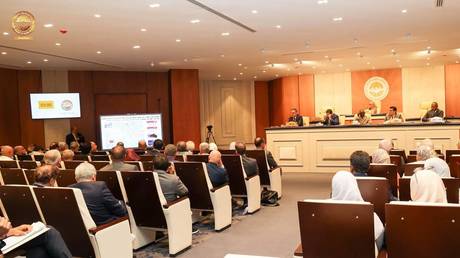
Libya’s eastern House of Representatives has unanimously ratified a contested maritime boundary agreement with Türkiye, reigniting a long-running dispute over energy rights and jurisdictional claims in the eastern Mediterranean that pits Ankara and Tripoli against Greece, Cyprus, and Egypt.
A Revived Agreement, A Renewed Controversy
The vote, taken on Tuesday, formally endorsed the memorandum of understanding first signed in November 2019 between Ankara and Libya’s internationally recognised government in Tripoli. In the same session, lawmakers reversed a 2020 resolution that had severed political ties with Türkiye, signalling a substantive shift in the eastern parliament’s diplomatic posture.
The agreement demarcates maritime jurisdiction between the two countries across a stretch of sea that Greece, Egypt, and Cyprus each regard as falling, at least in part, within their own sovereign zones. Its ratification by the eastern-based House of Representatives — an institution that had previously distanced itself from Tripoli’s foreign alignments — lends the deal a broader Libyan legitimacy its critics are determined to contest.
The Greek Foreign Ministry wasted no time. It condemned the parliamentary decision as “unilateral and legally unfounded,” arguing that the memorandum disregards the entitlement of Greek islands to maritime zones lying between the Turkish and Libyan coastlines. “The memorandum remains illegal, null and void, contravenes international law of the sea, and infringes upon the sovereign rights of states in the region,” the ministry declared, warning that Athens would take concrete action to defend its position. Cyprus issued an equally categorical rejection, employing identical language to describe the deal’s legal standing.
Ankara’s Rebuttal and the Energy Stakes
Türkiye’s Foreign Ministry offered a sharply different reading. It welcomed the vote as a measure that safeguards “the mutual rights and interests” of both countries under international law and the principle of equity, adding that Ankara would continue working with partners to promote stability across the Mediterranean basin. The ministry’s framing — emphasising legality and regional cooperation — reflects a consistent Turkish strategy of contesting the Greek-Cypriot interpretation of maritime entitlements under the United Nations Convention on the Law of the Sea, particularly as it applies to island territories.
The legal argument is not merely academic. Since 2009, a succession of significant offshore gas discoveries off Israel, Cyprus, and Egypt has transformed the eastern Mediterranean into one of the world’s most commercially consequential maritime theatres. International energy majors including Chevron and Eni have committed capital to the region, according to a US Energy Information Administration report, and competing boundary claims directly determine who controls the drilling rights. Greece deepened its own stake last year when Athens approved offshore exploration south of Crete by a Chevron-led consortium — a move Ankara formally objected to. Greece and Egypt also concluded their own overlapping maritime delimitation agreement in 2020, which Türkiye refuses to recognise.
Libya’s Shifting Internal Dynamics
Tuesday’s vote is inseparable from the evolving relationship between Türkiye and Libya’s eastern political and military establishment. Ankara intervened decisively in 2019 and 2020 to help the Tripoli-based government repel an offensive by forces loyal to military commander Khalifa Haftar, who sought to capture the capital. That intervention placed Türkiye firmly in the western camp. Yet Ankara has since broadened its diplomatic and commercial contacts eastward, cultivating ties with the Haftar-aligned administration that controls much of Libya’s territory beyond Tripoli.
Libya remains formally divided between Abdul Hamid Dbeibah’s government in Tripoli and an eastern administration led by Osama Hammad and backed by Haftar. Remarkably, officials from both rival administrations welcomed Tuesday’s parliamentary approval. The Tripoli-based Foreign Ministry described it as a “positive development toward strengthening bilateral relations” with Türkiye, while Saddam Haftar, deputy commander of the Libyan National Army and son of the eastern strongman, framed it as a step toward overcoming past differences in the service of Libyan national interests. That rare cross-factional consensus, however superficial it may prove, gives the agreement a political weight that will complicate efforts by Athens and Nicosia to have it set aside.