
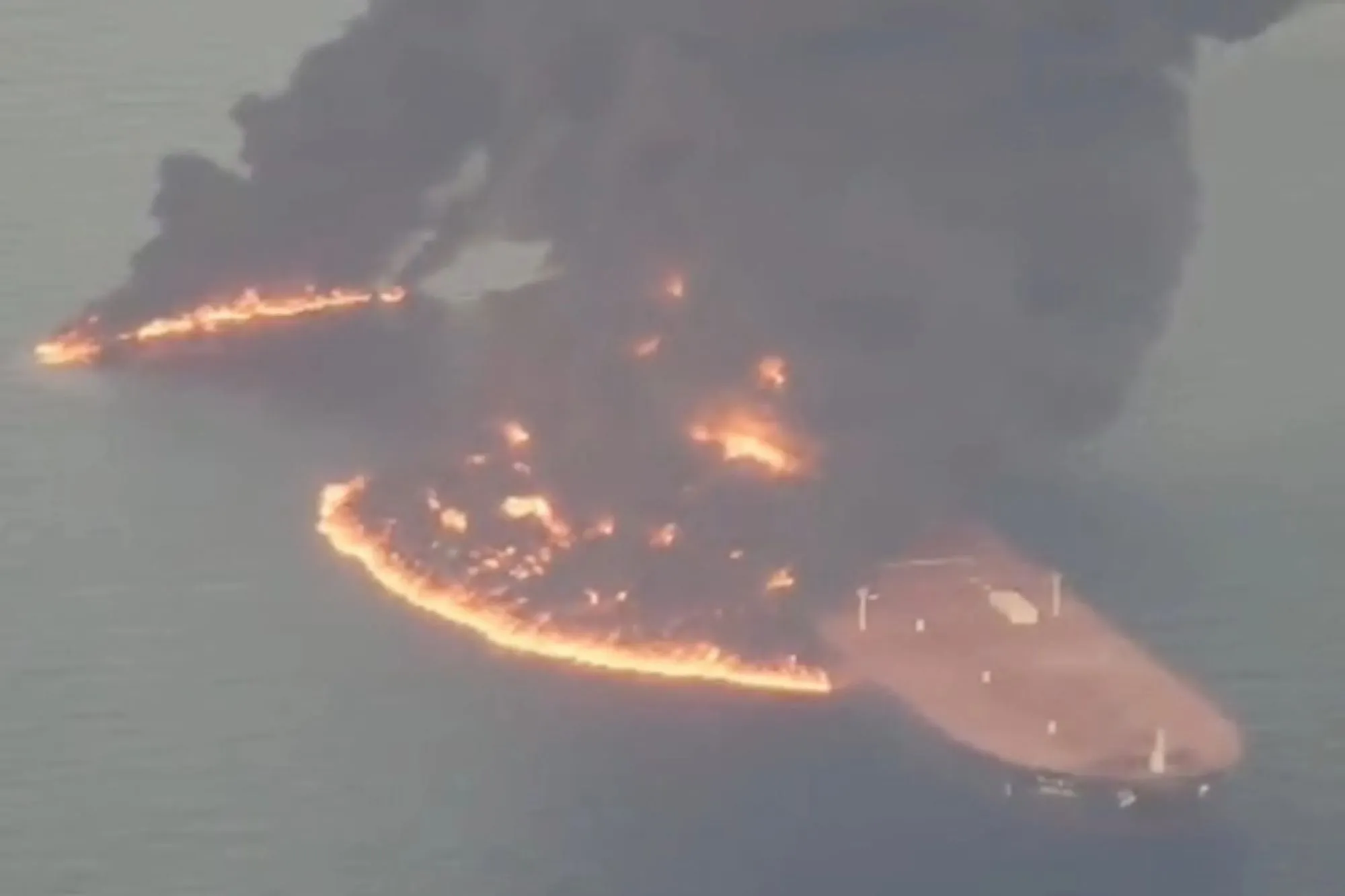
Tourist beaches along the coastline of the United Arab Emirates have been forced to close following a significant oil spill triggered by an Iranian attack on a Panama-flagged tanker near the Strait of Hormuz, an incident that underscores the mounting strategic and environmental costs of Tehran’s increasingly aggressive posture in one of the world’s most critical maritime corridors. Dramatic imagery circulating since the incident shows burning oil spreading across the sea and washing onto the white sandy shores around Umm Al Quwain, a northern emirate situated approximately 35 miles from Dubai, while residents in the area have reported a pervasive oil-like smell and social media footage has captured stretches of sea rendered entirely black.
The UAE’s Ministry of Climate Change and Environment confirmed that the affected beaches would be temporarily closed as authorities conduct clean-up operations and carry out environmental assessments, adding that any odours detected in the vicinity posed no immediate health risks to the population. Fishermen and beachgoers have been formally urged to avoid the contaminated areas and to comply with official instructions, a precaution that reflects both the scale of the spill and the broader logistical challenge of managing a pollution event in a densely visited coastal zone. The ministry’s measured public communications have so far sought to contain alarm, though the visual evidence emerging from satellite analysis tells a more sobering story.
According to satellite imagery analysed by the BBC, an oil slick emanating from the Gem No 2 had spread more than 22 miles from the stricken vessel, a figure that places the incident among the more consequential maritime pollution events the region has witnessed in recent memory. What initially appeared to be a relatively contained leak when first observed seeping from the ship on 19 October has expanded rapidly over the subsequent two days, a trajectory that will complicate the remediation effort considerably and raises questions about how swiftly the environmental response was mobilised. The tanker’s 22 Indian crew members were rescued and accounted for, with the Indian consulate in Dubai confirming their safety on 11 October, though the vessel itself remains a source of ongoing contamination.
The Gem No 2 was struck during what analysts have described as a record surge of vessel strikes by Iran between 9 and 10 October, as the Islamic Republic sought to assert greater control over the Strait of Hormuz, a chokepoint through which roughly a fifth of the world’s oil supply passes. Iranian state media characterised the tanker’s position as the result of an attempt to transit the strait via an “unauthorised and dangerous route,” a framing that serves Tehran’s broader narrative of sovereign enforcement but which sits uneasily alongside the human and environmental consequences now playing out along the UAE’s shores. Footage recorded aboard the Gem No 2 showed crew members running across the deck and donning life jackets as black smoke billowed over the ship, a scene that captured the immediate human peril before attention shifted to the slower-moving ecological disaster unfolding in the vessel’s wake.
The environmental stakes for the UAE are particularly acute, given that the nation depends on coastal desalination plants for the vast majority of its potable water, meaning that any sustained shoreline pollution carries implications well beyond the tourism sector and into the foundations of everyday civic life. Oil spills are well understood to release a cocktail of chemicals and metals that form a toxic physical barrier on the water’s surface, disrupting marine ecosystems through both immediate physical contact with wildlife and the long-term chemical toxicity that persists long after visible contamination has been addressed. The UAE’s core economic infrastructure, encompassing major industrial hubs and commercial ports concentrated along the coast, faces compounding exposure the longer the spill remains uncontained.
This incident represents the second significant maritime pollution event to affect the region within a matter of months, following an August episode in which a tanker ran aground near Oman and eventually leaked crude oil that washed ashore. The pattern is difficult to ignore: a combination of geopolitical instability, aggressive Iranian maritime conduct, and the sheer volume of hydrocarbon traffic through the Gulf creates conditions in which such episodes are less exceptional than they might appear. For policymakers and financiers with exposure to Gulf infrastructure, the question is no longer whether incidents of this kind will recur, but how robustly the region’s environmental and strategic frameworks are equipped to absorb them.