
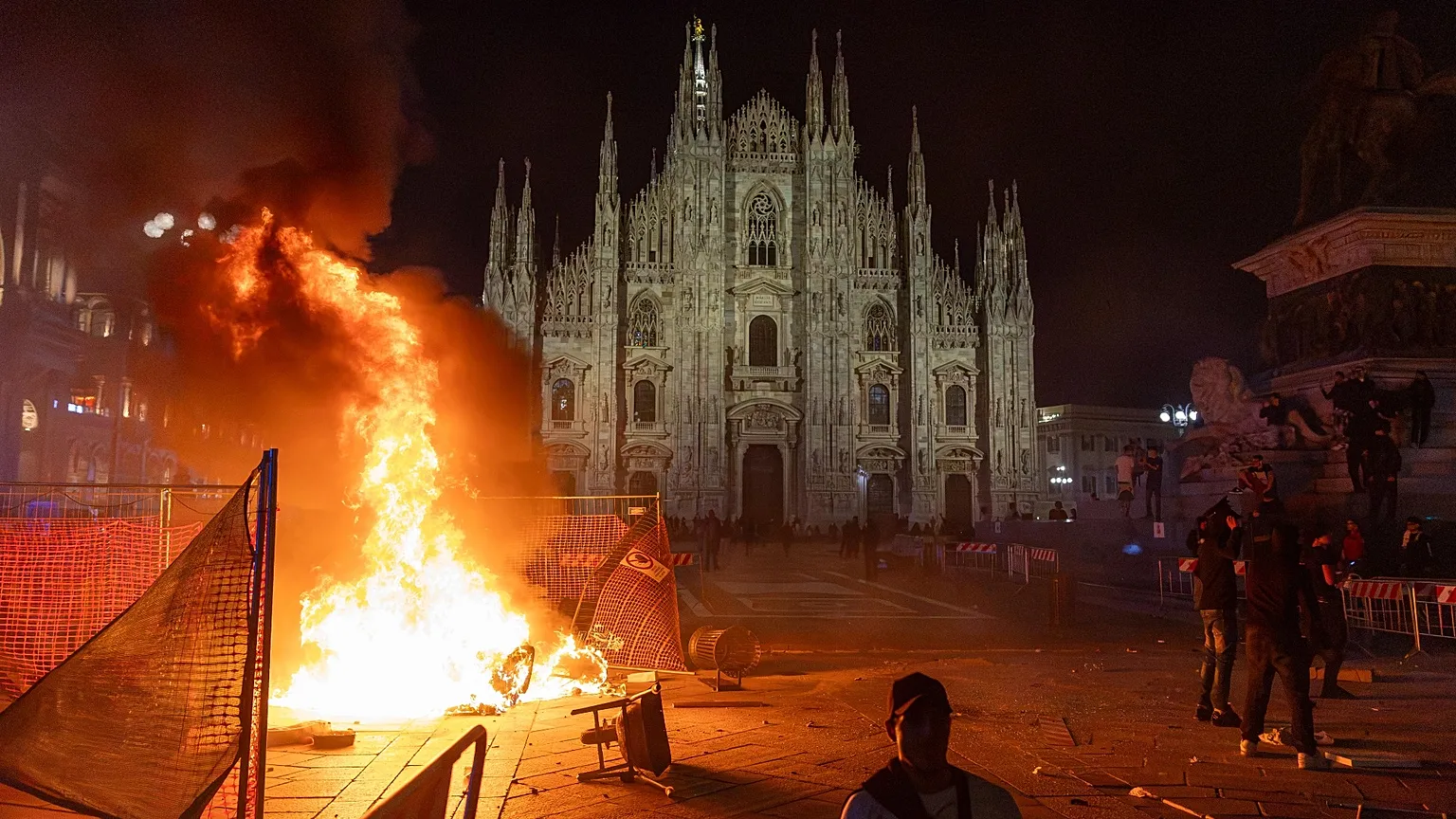
Milan’s centre held for a second consecutive day on Sunday as black-clad assailants clashed with police around the Duomo plaza, looting shops, overturning rubbish bins and hurling bottles at officers — a spectacle that has now drawn the personal attention of Prime Minister Giorgia Meloni.
The Scale of the Disorder
Police in Milan have arrested more than 200 people since Saturday, according to the Ansa news agency, after violence broke out on the margins of a sanctioned cost-of-living demonstration. Officers deployed tear gas and water cannon on Sunday to disperse crowds, many of whom wore masks as they threw objects at police vehicles. A supermarket on a shopping street adjacent to the Duomo plaza was ransacked, and scooters and bicycles were vandalised across the square.
The disorder was not confined to Milan. Similar disturbances erupted in the northern cities of Bologna and Turin in the wake of separate protests, suggesting a degree of coordination — or at least contagion — that will unsettle security planners across the country.
Political Response
Meloni convened a security meeting for Monday to address the unrest, having already issued a pointed statement on Saturday. “To demonstrate is a right. To lay our cities to waste is not,” she wrote on X, describing the perpetrators as “thugs who exploit demonstrations to spread chaos, attack those who guarantee security, and hold entire cities hostage.” The language was unambiguous: the government draws a firm line between legitimate protest and criminal violence.
Milan’s mayor, Giuseppe Sala, was equally direct. Having witnessed “smashed shop windows, looted stores, and frightened citizens” first-hand, he told Ansa that the phenomenon carried an international dimension. “What happened here is what we are seeing in many cities around the world,” he said. “I’m very worried because it’s a new phenomenon, which also originates from an international scenario and therefore feeds itself.” The comparison to recent scenes of looting in Paris was made explicitly by Meloni’s office.
Key Takeaways
The episode raises uncomfortable questions about the capacity of European cities to contain disorder that originates in legitimate economic grievance but is rapidly captured by elements intent on destruction. For the Meloni government, the priority is clear: restoring order while preserving the distinction between the right to protest and the licence to riot. Whether the security meeting on Monday produces concrete measures — or merely reassuring statements — will be the first real test of that resolve.