
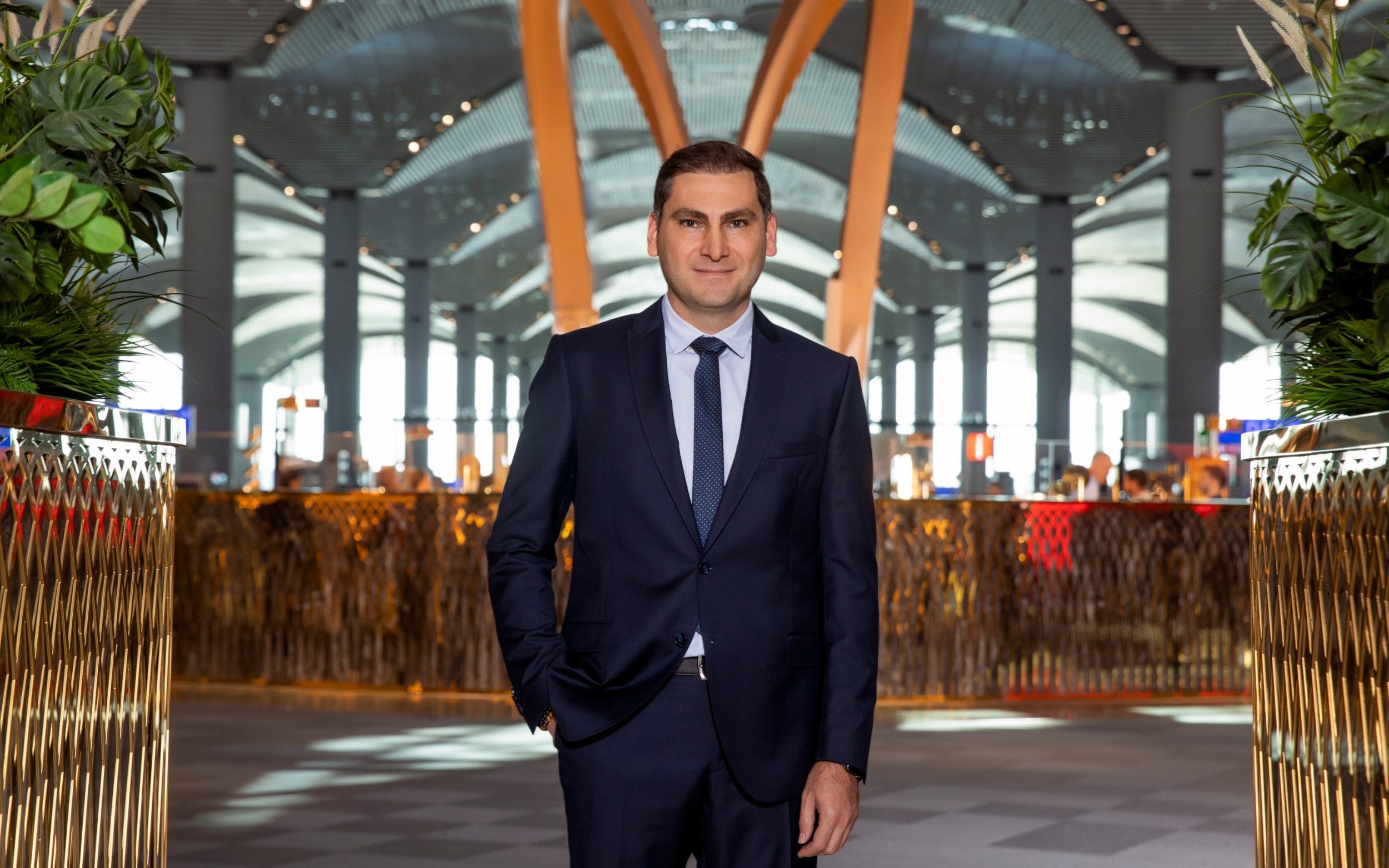
On a brownfield site riddled with open-cast mine workings, twenty miles north of Istanbul and close to the Black Sea, stands what has quietly become one of the most consequential infrastructure decisions of the early twenty-first century. Istanbul Airport, which opened in 2018 at a construction cost of just £9 billion, recently displaced Heathrow as Europe’s busiest hub. It is now on course to overtake Chicago and Dallas and enter the ranks of the world’s top five airports. Its chief executive, Selahattin Bilgen, surveys this trajectory with understandable satisfaction — and, when asked about Britain’s own airport saga, with barely concealed disbelief.
“It was not an easy decision in our country to build a new airport,” Bilgen told reporters this week. “And in a country like yours I understand that there are many other factors that may distort the decision-making processes.” He paused before adding: “It takes a brave move to design a brand new airport and move all the operations, but it is the best move.”
Britain, of course, chose the other move. Decades of commissions, consultations, legal challenges, and political reversals have produced a plan to add a third runway to Heathrow at an expected cost of £49 billion — more than five times what Turkey spent building an entirely new hub from scratch. Even if that runway opens within the decade, Heathrow will find itself capped at roughly 140 million passengers annually, having extended as far as physically possible, crossing even the M25. There will, as Bilgen puts it, be “nowhere else to grow.” Istanbul, by contrast, is already expanding from 90 million passengers to 120 million, with a long-term blueprint to reach 200 million and potentially become the world’s largest airport.
The contrast is sharpest when viewed through the lens of institutional decision-making. In the early 2000s, both Britain and Turkey confronted near-identical problems. Istanbul’s Atatürk Airport, opened in 1953, was hemmed in by the city on three sides and the Sea of Marmara on the fourth — a situation strikingly analogous to Heathrow’s entrapment between London’s suburban sprawl, the M25, and the M4. Turkish experts, like their British counterparts, initially argued for the path of least resistance: squeeze in another runway, buy another decade or two of capacity, and avoid the political and logistical disruption of starting afresh.
What shifted the debate in Turkey was a strategic argument rather than a narrow technical one. A new airport, its proponents contended, would not merely serve domestic needs but exploit Turkey’s geographic position at the crossroads of Europe, Africa, and Asia to build a genuinely global hub. That vision was enough to secure the backing of Recep Tayyip Erdoğan, then Istanbul’s mayor and subsequently prime minister. Bilgen is candid that political leadership was decisive, but he is equally clear that it required public persuasion. “His decisions are influenced by the public as well,” he said of Erdoğan, “so it was also important to have the common audience supporting the project, to make people believe.”
Britain’s political economy has consistently struggled to replicate that alignment. Harold Wilson’s Roskill Commission proposed a new airport in Buckinghamshire. Edward Heath backed a hub at Maplin Sands in the Thames Estuary. Norman Foster presented detailed plans for a Thames Hub Airport on the Isle of Grain. Boris Johnson, as London mayor, championed a site near Whitstable — inevitably dubbed Boris Island. Each proposal foundered on the same combination of local opposition, inter-departmental inertia, and the gravitational pull of the existing Heathrow infrastructure. The Davies Commission report of 2015 ultimately ruled out every alternative, endorsing an enlarged Heathrow as the only viable option.
The operational design of Istanbul Airport adds a further dimension to the comparison. The hub was built around a single terminal — the largest in the world — handling all flights under one roof. The logic was straightforward: multiple terminals create friction for transfer passengers, complicate baggage handling, and erode the punctuality and reliability metrics that define a competitive hub. “We put the passenger journey in the centre,” Bilgen explained. “If we had several terminals, so many transfer passengers would be going from one terminal to another. There could be issues with the baggage. It could create a mess and friction.” The result is a hub that leads Europe on both delay rates and lost luggage, metrics that matter acutely to the airlines and corporate travellers who generate the highest-value traffic.
The financial architecture is equally instructive. Istanbul Airport was privately funded, with operator IGA — owned by Turkish construction groups Kalyon and Cengiz — holding a 25-year concession before control reverts to the Turkish government, and paying rent throughout. Because construction costs were a fraction of Heathrow’s, the operating fees charged to airlines are correspondingly lower, a competitive advantage that compounds over time. Bilgen did not shy away from the implication for Heathrow. “If you are able to build an airport at a low cost then you are able to provide a service with low charges and it turns out to be a better option for airlines,” he said. He acknowledged that Heathrow retains powerful advantages — its slot queue remains long — but warned that “developing an airport at a competitive cost reflects itself in the airport charges afterwards and impacts the competitive power of the airport. That’s a fact.”
There is, of course, a risk that Heathrow’s high charges will suppress demand for its new capacity, a concern Bilgen raised directly. Heathrow’s defenders would note that its catchment area, its established airline relationships, and its role as a transatlantic gateway give it a resilience that no greenfield rival can easily replicate. Those are real advantages. But they are advantages that were also available to a well-designed replacement airport, and they do not obviously justify a cost premium of £40 billion over the Turkish model.
The migration from Atatürk to Istanbul Airport remains a remarkable footnote to this story. Critics predicted chaos. In the event, 20,000 staff and 10,000 pieces of equipment weighing 50,000 tonnes were relocated in 29 hours. The operation, which became known simply as “the great move,” passed without significant incident. It demonstrated that the logistical objections to a new-build strategy, however formidable they appear in advance, are not insuperable — provided the institutional will exists to overcome them.
That will, in Britain, has been conspicuously absent. The cost of that absence is now measured not merely in billions of pounds of avoidable construction expenditure, but in the slower, quieter erosion of a competitive position that, once surrendered, is very difficult to reclaim.